
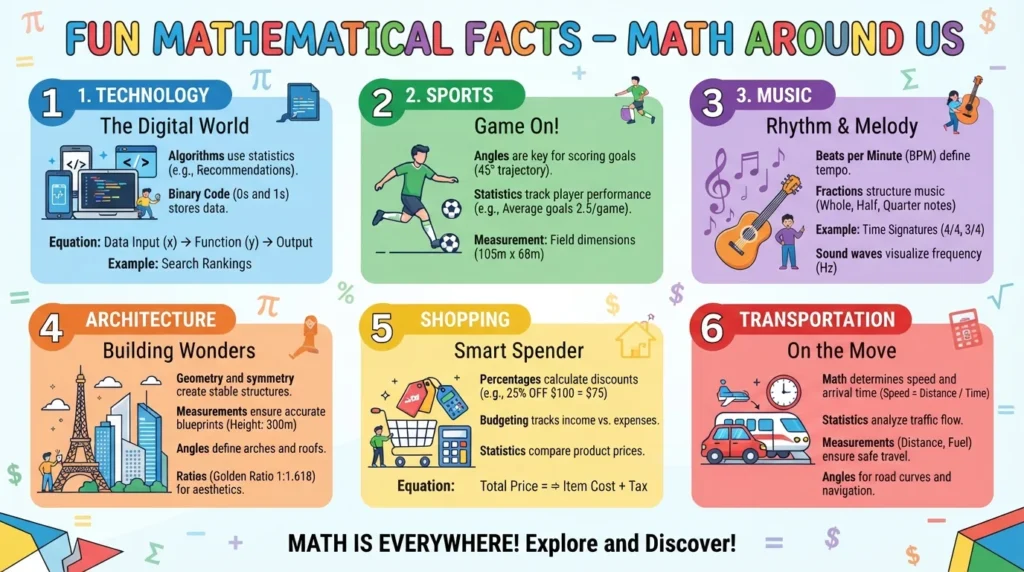
Exploring fun mathematical facts reveals how numbers govern the hidden patterns of our universe, from the secret symmetry of pinecones to probability paradoxes in everyday life. Math is not just formulas; it is a fascinating language full of surprising patterns, brain-bending paradoxes, and practical wonders waiting to be discovered.
Have you ever looked at a simple clock face or a sunflower and realized a secret numerical code was hiding in plain sight? Numbers are so much more than dry formulas on a dusty classroom chalkboard.
Discovering fun mathematical facts turns everyday counting into an exciting adventure through patterns, paradoxes, and mental tricks. You do not need an advanced degree to appreciate how numbers shape our daily world.
Let us explore some of the most surprising, entertaining, and mind-bending fun mathematical facts that will change how you look at numbers forever.
The Surprising World of Everyday Numbers
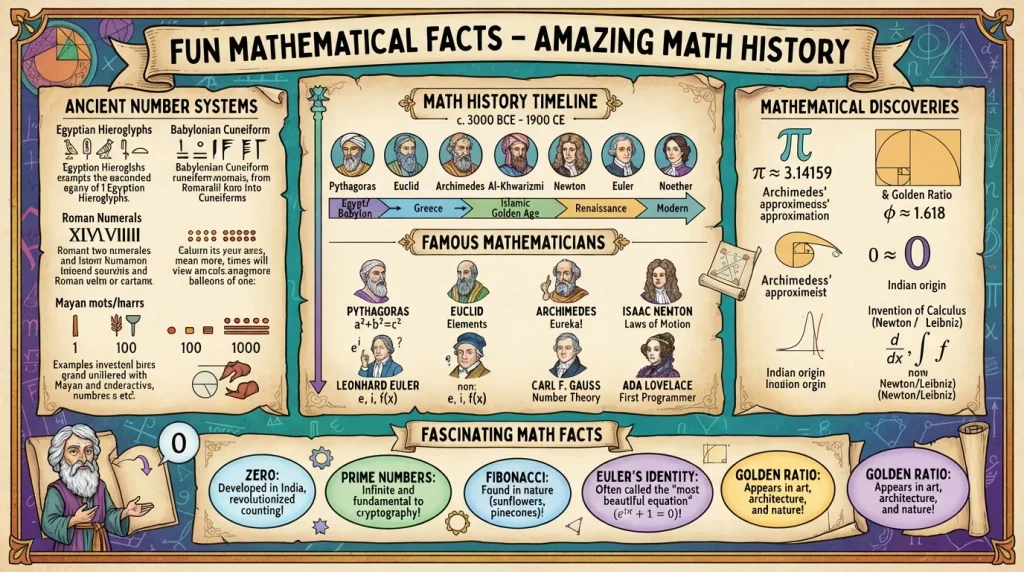
Numbers surround us constantly, yet we rarely pause to think about their unique personalities. Every single digit has a story to tell if you know where to look.
Why Zero Changed Human History Forever
Imagine trying to write a huge number like ten thousand without using the symbol zero. Ancient civilizations struggled for centuries with complex tallies that made basic calculation a nightmare.
The invention of zero as both a place-holder and an actual quantity revolutionized trade, science, and navigation. It allowed mathematicians to perform complex algebra and gave birth to the digital code running our computers today.
The Special Magic of the Number Seven
Ask a room full of people to pick a random number between one and ten, and a huge majority will choose seven. Culturally and mathematically, seven holds a truly unique spot in our collective imagination.
It is the only single-digit number that cannot be multiplied or divided by any other single-digit number within that one-to-ten range. This mathematical isolation makes seven feel special, rare, and mysterious across almost every global culture.
The Unique Oddity of Number Two
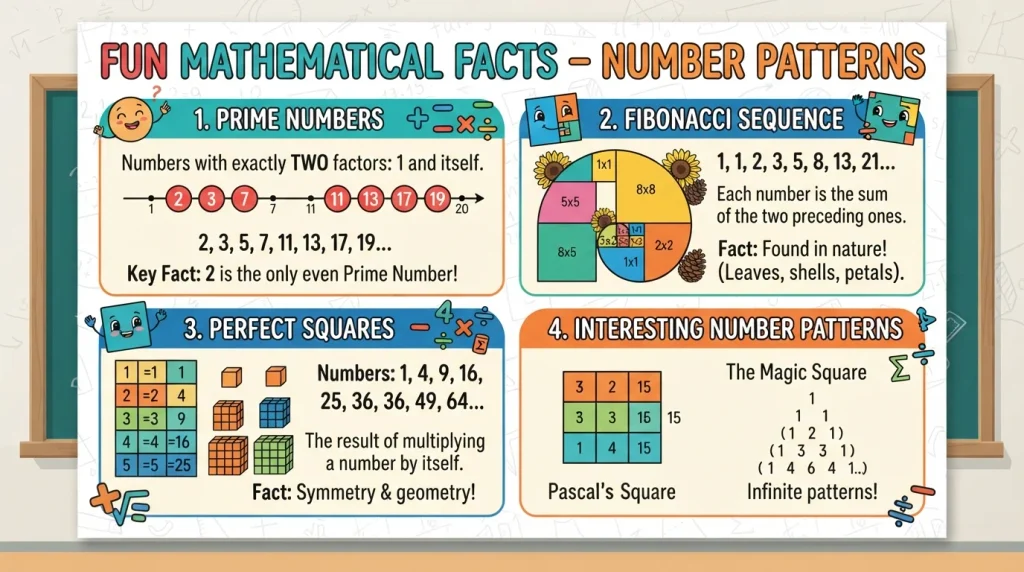
We usually associate even numbers with balance and symmetry, but two is the absolute wild card of the group. It is the smallest prime number and the only even prime number that exists in the entire infinite universe.
Every other even number can be divided neatly by two, which immediately disqualifies them from being prime. Two stands completely alone as the gateway between simple counting and complex prime theory.
Mind-Blowing Numerical Tricks and Patterns
Number patterns are like hidden magic tricks built directly into the fabric of mathematics. Once you spot them, you can perform incredible mental arithmetic without sweating.
The Symmetry of Palindromic Numbers
A palindrome is something that reads the exact same forward and backward, like the word radar. Numbers do this too, and they create some of the cleanest visual patterns in basic math.
Take a look at what happens when you multiply numbers consisting only of the digit one:
- 1 multiplied by 1 equals 1
- 11 multiplied by 11 equals 121
- 111 multiplied by 111 equals 12,321
- 1,111 multiplied by 1,111 equals 1,234,321
- 11,111 multiplied by 11,111 equals 123,454,321
The sequence counts cleanly up to the central digit and then counts right back down.
The Secret 1089 Trick to Wow Your Friends
You can impress anyone with a fast, foolproof mathematical magic trick using basic subtraction and addition. Ask a friend to write down any three-digit number where the first and last digits differ by at least two.
Have them reverse the digits and subtract the smaller number from the larger number. Next, tell them to reverse that answer and add it to itself.
No matter what starting number they choose, the final result will always equal 1089.
Why Percentages Are Completely Reversible
Calculating tricky percentages in your head can feel like a chore, but a simple mathematical secret makes it easy. Percentages are completely reversible, meaning x percent of y is always equal to y percent of x.
If you need to find 16 percent of 50 in your head, it might feel tough at first glance. Flip the problem around and calculate 50 percent of 16 instead.
Both calculations give you the exact same answer of 8, but the second way takes only a fraction of a second to solve.
Nature’s Favorite Math: The Fibonacci Sequence
When you look closely at natural growth, you quickly realize that nature is a master mathematician. Plants, animals, and natural shells all rely on a specific numerical sequence to grow efficiently.
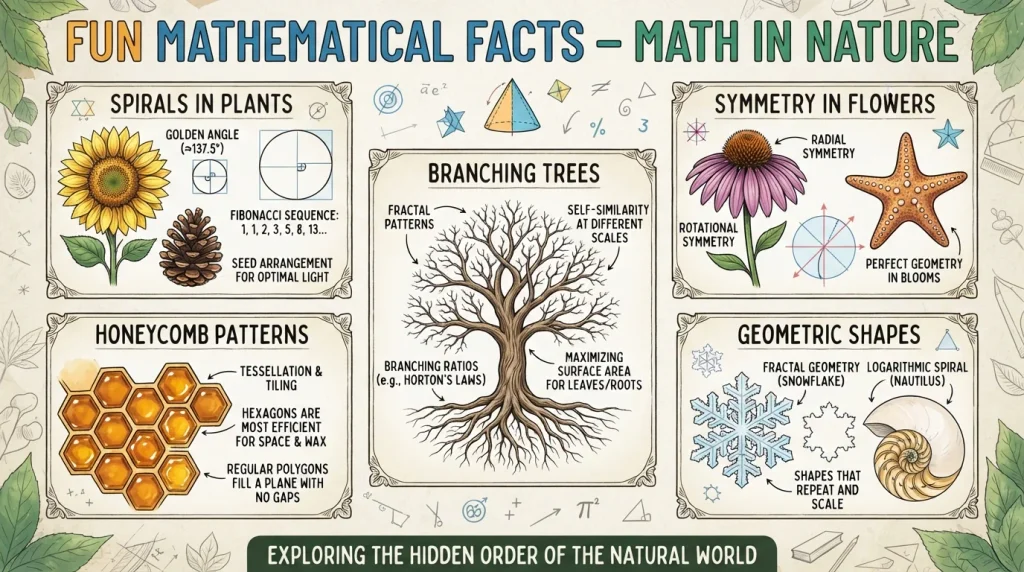
How Pinecones and Sunflowers Use Math
The Fibonacci sequence is a series of numbers where each number is the sum of the two preceding ones. It starts simple: 0, 1, 1, 2, 3, 5, 8, 13, 21, 34, and continues forever.
If you count the spiral rows on a pinecone or a sunflower seed head, you will almost always find a Fibonacci number. This specific arrangement allows seeds to pack together as tightly as possible without wasting precious space.
The Golden Ratio in Art and Architecture
When you divide any Fibonacci number by the one right before it, the answer gets closer and closer to 1.618. This famous value is known as the Golden Ratio, or Phi.
Artists, architects, and designers have used this exact ratio for thousands of years to build visually pleasing structures. You can spot the Golden Ratio in famous works like the Parthenon in Greece, the Mona Lisa, and even modern corporate logos.
Spiral Shells and Galaxy Patterns
The Golden Ratio creates a smooth, expanding logarithmic spiral when drawn out visually. This golden spiral shows up in the curved shells of sea creatures like the nautilus.
It also appears on a massive cosmic scale in the swirling arms of spiral galaxies floating across deep space. It is a striking reminder that the microscopic world and outer space share the same foundational math.
Mind-Bending Probability Paradoxes
Probability measures how likely something is to happen, but human intuition is notoriously terrible at guessing real odds. These famous paradoxes prove that math often defies our basic gut feelings.
The Birthday Paradox That Baffles Everyone
If you put a small group of people in a room, what are the odds that two of them share an exact birthday? Most people guess you would need at least 150 or 200 people to reach a 50 percent chance.
The actual mathematical answer is a surprising 23 people. Because you are checking every possible pair of people in the room rather than matching one person, the odds rise shockingly fast.
With 57 people in a room, the probability that two people share a birthday surges past 99 percent.
The Monty Hall Problem: Should You Switch Doors?
Imagine you are on a game show with three closed doors. Behind one door is a brand new car, while the other two doors hide goats.
You pick Door Number One. The host, who knows what is behind every door, opens Door Number Three to reveal a goat, and then asks if you want to switch to Door Number Two.
Your gut tells you it is a 50-50 choice, so switching should not matter. Math proves that switching doubles your chances of winning from one-third to two-thirds.
When you first picked, you had a two-thirds chance of picking a goat. By opening a goat door, the host concentrated all the remaining winning probability into the single untouched door.
The Coin Toss Fallacy
If you flip a fair coin ten times and it lands on heads every single time, what are the odds for the eleventh flip? Many people mistakenly believe that tails is due to happen next.
This mistake is called the Gambler’s Fallacy. The coin has no memory, so the chance of landing on heads remains exactly 50 percent every single time you flip it.
Geometry and Shape Secrets
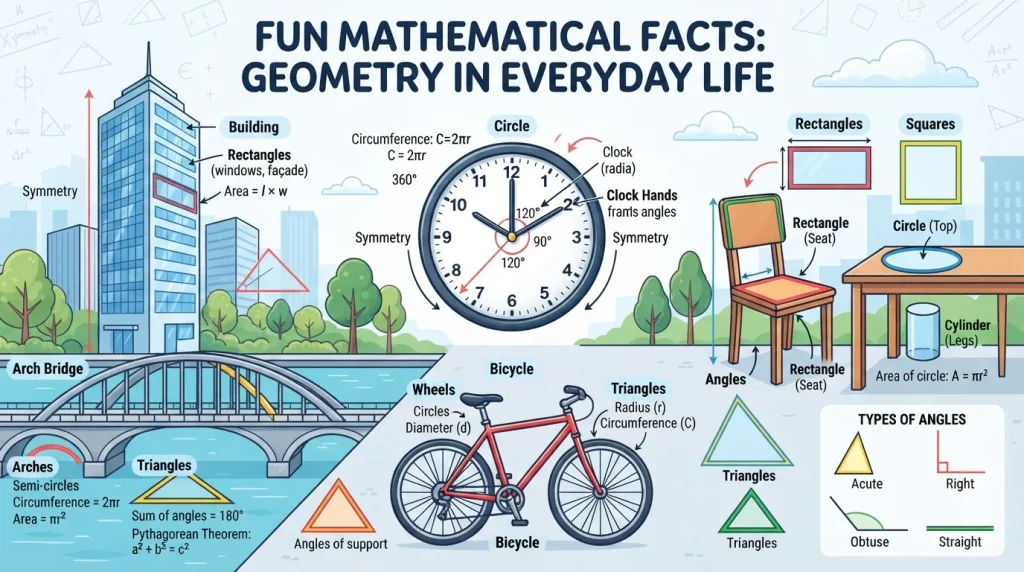
Geometry is not just about measuring triangles on grid paper. The shapes that fill our physical space carry brilliant practical advantages designed by mathematical laws.
Why Bees Love the Hexagon
Have you ever wondered why honeybees construct their hives using perfect six-sided hexagons instead of circles or squares? Bees need to store as much honey as possible while spending minimal energy producing beeswax.
Mathematically, a hexagonal grid is the most efficient way to divide a two-dimensional surface using equal-sized shapes. It leaves zero wasted gaps while using the absolute smallest boundary perimeter possible.
The Secret Strength of Triangles
Look at modern bridges, roof trusses, or crane towers, and you will see triangles everywhere. Unlike squares or rectangles, a triangle cannot deform without breaking one of its sides or changing its edge lengths.
When you apply force to a triangle, the stress distributes evenly across all three sides. This structural rigidity makes it the strongest fundamental shape in construction engineering.
Möbius Strips: The Shape with Only One Side
Take a thin strip of paper, give one end a half-twist, and tape the two ends together. You have just created a Möbius strip, an incredible geometric object with only one surface and one edge.
If you take a pencil and draw a continuous line down the middle of the paper loop, you will cover both sides without ever lifting your pencil. Engineers use Möbius strips for industrial conveyor belts so the belt wears down evenly on all sides.
Amazing Historical Math Mysteries
Human history is filled with brilliant thinkers who spent their entire lives trying to solve strange mathematical puzzles. Some of these mysteries took centuries of hard work to unlock.
Fermat’s Last Theorem and the Margin Note
In 1637, a French mathematician named Pierre de Fermat wrote down a simple equation in the margin of an old textbook. He claimed he had a brilliant proof for it, but wrote that the margin was too narrow to fit his explanation.
That simple claim tormented the world’s greatest mathematicians for over 350 years. Nobody could prove it until British mathematician Andrew Wiles finally solved it in 1994 using advanced modern geometry.
The Ancient Mystery of Prime Numbers
Prime numbers are whole numbers greater than one that can only be divided by one and themselves, like 2, 3, 5, 7, and 11. They act as the basic building blocks for all other numbers.
Even though ancient Greeks proved there are infinite prime numbers thousands of years ago, no simple formula predicts when the next prime will appear. Modern digital security and online banking encryption rely entirely on the extreme difficulty of factoring giant prime numbers.
The Endless Story of Pi
Pi represents the ratio of a circle’s circumference to its diameter, starting with the familiar digits 3.14159. It is an irrational number, meaning its decimals go on forever without ever establishing a repeating pattern.
Supercomputers have calculated Pi out to tens of trillions of digits without finding a loop. Even more fascinating, because the digits are infinite and random, your phone number, birthday, and Social Security number are hidden somewhere in Pi.
Practice Exercise
Test your understanding of these numerical concepts with these quick questions.
- What is the only even prime number?
A) 1
B) 2
C) 3
D) 4 - What is the value of 0! (zero factorial)?
A) 0
B) 1
C) 2
D) 10 - Which number is known as the mathematical constant approximately equal to 3.14159?
A) Pi
B) Phi
C) Euler’s number
D) Tau - What is the smallest perfect number?
A) 4
B) 6
C) 8
D) 10 - Which number is neither positive nor negative?
A) 0
B) 1
C) -1
D) 2 - What is the square root of 144?
A) 10
B) 11
C) 12
D) 14 - How many sides does a hexagon have?
A) 5
B) 6
C) 7
D) 8 - Which sequence begins 1, 1, 2, 3, 5, 8?
A) Fibonacci sequence
B) Prime sequence
C) Square sequence
D) Even sequence - What is the name for a number that can only be divided evenly by 1 and itself?
A) Prime number
B) Perfect number
C) Whole number
D) Composite number - What is 10 × 10?
A) 10
B) 50
C) 100
D) 1,000
Answer Key:
1-B | 2-B | 3-A | 4-B | 5-A | 6-C | 7-B | 8-A | 9-A | 10-C
FAQs
What are fun mathematical facts suitable for beginners?
Simple tricks like reversing percentages make math approachable and fun. For instance, calculating 4 percent of 75 feels tough, but computing 75 percent of 4 instantly gives you 3.
Why is zero considered such an important invention?
Zero serves as both a numerical value and a crucial position marker. Without zero, performing basic arithmetic, tracking place values, and building computer code would be nearly impossible.
How does the Fibonacci sequence show up in everyday nature?
Plants use the Fibonacci sequence to optimize their growth patterns. You can count these specific numerical spirals in sunflower seeds, pinecone scales, pineapples, and expanding seashells.
Is math really a universal language?
Math relies on logical relationships that remain true everywhere in the cosmos. Whether you are on Earth or a distant galaxy, geometric rules and prime numbers operate identically.
Why do mathematicians care so much about prime numbers?
Primes are the atomic building blocks of arithmetic because every whole number is built from them. They are also vital for modern cybersecurity, encrypting online transactions every day.
What is the practical use of the Golden Ratio?
The Golden Ratio creates visually balanced proportions that humans naturally find beautiful. Artists, architects, and web designers use it to craft appealing layouts, buildings, and products.
Conclusion
Exploring these fun mathematical facts proves that numbers are far more than boring equations on a textbook page. Math is a living language that explains the growth of flowers, the strength of bridges, and the hidden odds of everyday events.
Once you start looking for numerical patterns around you, the world becomes a far more interesting place. From reversible percentage tricks to nature’s golden spirals, math offers endless surprises for curious minds.
Which math fact blew your mind the most today? Share these fun numerical secrets with a friend, and keep exploring the amazing world of numbers!

Asjad Ali is a passionate, fun, and entertainment enthusiast who enjoys discovering interesting, amusing, and engaging content from around the web. Through laughvista.com, Asjad shares lighthearted ideas, entertaining stories, fun facts, jokes, and enjoyable content designed to bring a little more laughter and positivity into everyday life. His goal is to create content that feels natural, relatable, and easy for everyone to enjoy.
With a genuine interest in fun and entertainment, Asjad Ali focuses on creating friendly content for readers of different ages and backgrounds. laughvista.com is built around the idea that a few moments of laughter can brighten anyone’s day. Whether readers are looking for something funny, interesting, or simply entertaining, Asjad aims to make every visit enjoyable, refreshing, and worth coming back to.