
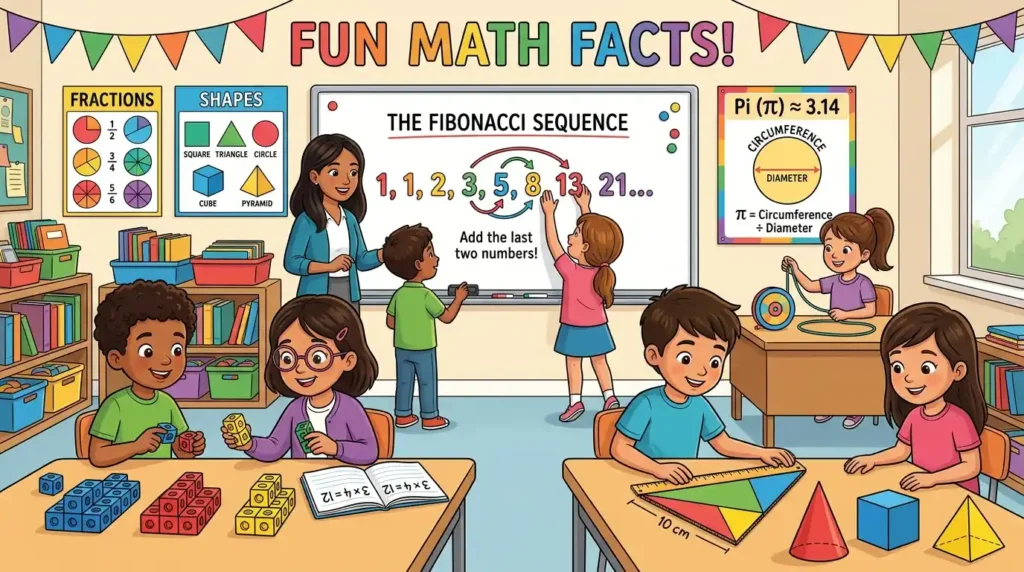
Fun math facts reveal the surprising, beautiful, and playful hidden patterns behind numbers, shapes, and everyday logic. From mind-boggling quirks like the birthday paradox to fascinating numerical symmetries, these facts show that mathematics is not just about memorizing boring formulas, but rather an exciting language that describes how our universe works.
Have you ever wondered if numbers hold secrets that could completely change how you see the world? Mathematics is often taught as a set of rigid rules, but it is actually full of strange paradoxes and incredible patterns.
Exploring fun math facts opens up a whole new perspective on how numbers shape everything around us. Get ready to discover some truly mind-blowing truths that make learning math an absolute joy.
Why Math Is Way More Fun Than You Think
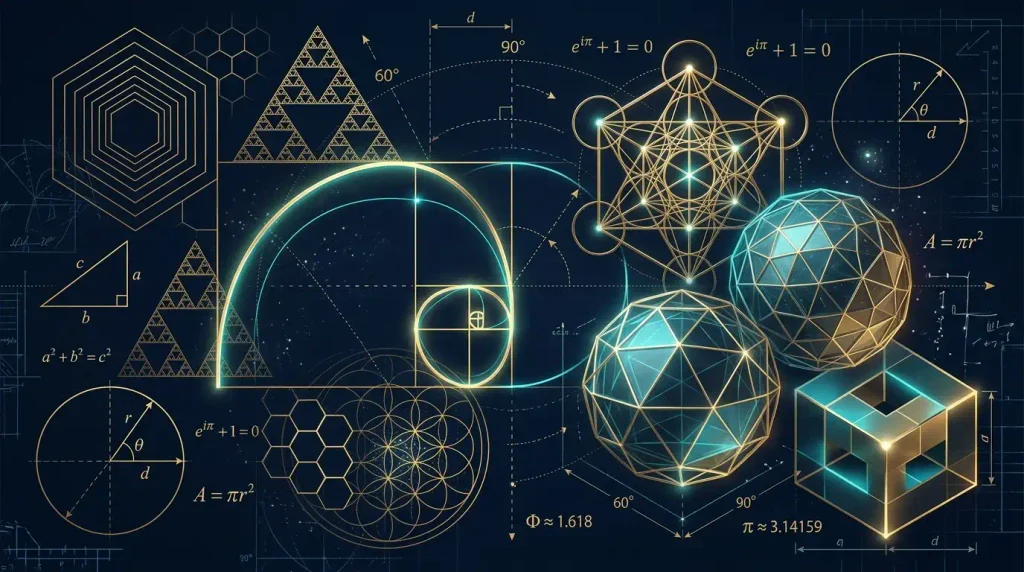
Many people remember math as an endless series of tests, memorization, and stressful chalkboard equations. However, when you step away from the classroom textbooks, you find a world filled with clever puzzles and jaw-dropping discoveries.
Numbers are not just abstract concepts created by humans to solve accounting problems. They form the underlying code of nature, music, art, and even games.
Breaking the Myth of the Math Mind
You do not need to be a born genius to appreciate the beauty of mathematics. In fact, thinking that some people have a math brain while others do not is a total myth.
Math is simply the study of patterns, and human brains are naturally built to recognize patterns everywhere. Once you start seeing numbers as clues in a cosmic mystery, the anxiety fades away.
The Hidden Magic in Everyday Numbers
Numbers govern almost every single action we take throughout the day without us even realizing it. From the digital code running your favorite mobile apps to the subtle geometry of architectural designs, numbers are hard at work.
When you learn to spot these hidden numerical connections, ordinary daily routines transform into intriguing puzzles waiting to be solved.
Mind-Blowing Number Quirks That Sound Like Magic
Some numerical properties seem so strange that they feel like magic tricks rather than strict scientific logic. Let us explore a few shocking properties of basic arithmetic that will leave your friends completely amazed.
The Surprising Secret of Percentages
Did you know that percentages are completely reversible in basic arithmetic? This means that finding $x$ percent of $y$ gives you the exact same result as finding $y$ percent of $x$.
For instance, trying to calculate $4\%$ of $50$ in your head might feel a bit tricky at first glance. But if you flip the problem around and calculate $50\%$ of $4$, the answer is instantly obvious: it is $2$.
- $4\%$ of $50 = 2$
- $50\%$ of $4 = 2$
This simple mental trick works for any pair of numbers you choose to test. It turns tricky mental math into a fast, effortless piece of cake.
The Strange Magic of Number 9
The number nine holds a uniquely special place in arithmetic because of its strange digital patterns. If you multiply nine by any whole number, the sum of the digits in the answer will always reduce down to nine.
- $9 \times 5 = 45$, and $4 + 5 = 9$
- $9 \times 9 = 81$, and $8 + 1 = 9$
- $9 \times 12 = 108$, and $1 + 0 + 8 = 9$
This curious pattern continues infinitely across the entire number line. It serves as a handy trick for quickly checking if a large number is evenly divisible by nine.
Kaprekar’s Constant: The Number 6174
Indian mathematician D. R. Kaprekar discovered a mysterious numeric routine in 1949 that always leads to the number $6174$. Take any four-digit number with at least two distinct digits and follow these simple steps:
- Arrange the four digits in descending order to form the largest possible number.
- Arrange the same digits in ascending order to form the smallest possible number.
- Subtract the smaller number from the larger number.
- Repeat the process with the new four-digit result.
No matter which starting number you choose, you will always land on $6174$ in seven steps or fewer. Once you hit $6174$, repeating the process keeps returning $6174$ forever.
How Famous Math Concepts Work in Real Life
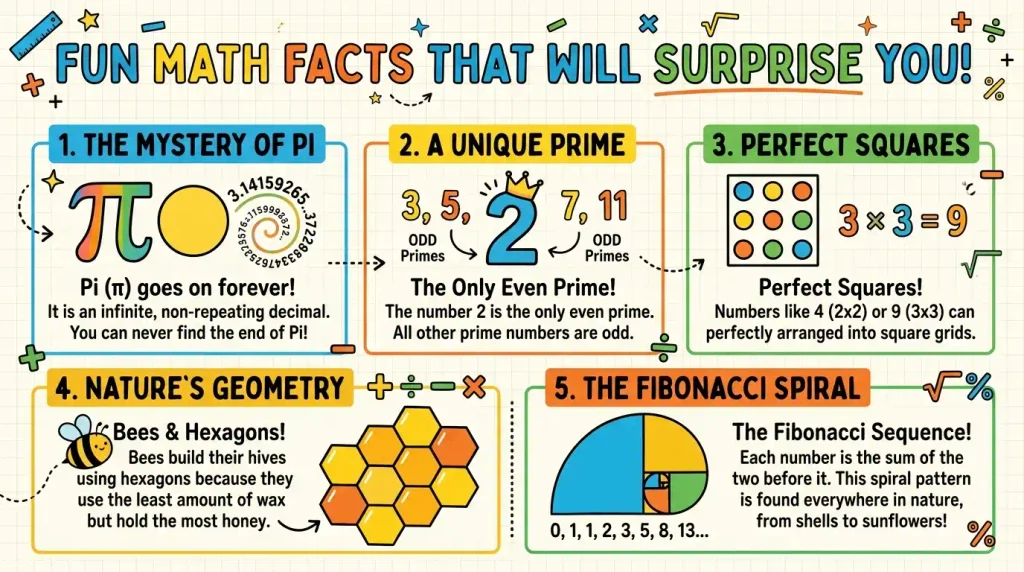
To help you understand how math connects to the real world, here is a simple look at four famous mathematical concepts:
- Fibonacci Sequence: Each number is created by adding the two preceding ones. You can see this pattern in nature, such as in pinecone spirals and sunflower seed arrangements.
- Kaprekar’s Constant: A four-digit subtraction routine that always reaches the number $6174$. It is commonly used in interactive numerical puzzle tricks.
- Birthday Paradox: In a room of just $23$ people, there is a $50\%$ chance two share a birthday. You can test this at event crowds and sports team gatherings.
- Möbius Strip: A physical object with only one continuous surface and one edge. It is used practically in conveyor belts and artistically in sculptures.
Nature’s Favorite Numbers and Shapes
If you look closely at the natural world around you, you will notice that nature is a master mathematician. From flower petals to giant spiral galaxies, physical forms follow precise numerical frameworks.
The Fibonacci Sequence in Your Backyard
The Fibonacci sequence is a famous series of numbers where each number is found by adding up the two numbers before it. It starts simply: $0, 1, 1, 2, 3, 5, 8, 13, 21, 34$, and continues forever.
- $0 + 1 = 1$
- $1 + 1 = 2$
- $1 + 2 = 3$
- $2 + 3 = 5$
- $3 + 5 = 8$
Plants use this sequence to optimize space and maximize exposure to light and rain. You can count the spirals on pinecones, pineapples, and sunflower heads to find Fibonacci numbers in action.
The Golden Ratio: Nature’s Perfect Proportion
Dividing consecutive numbers in the Fibonacci sequence gets you closer and closer to an irrational number known as the Golden Ratio, roughly equal to $1.618$. Artists, architects, and designers have used this aesthetic ratio for centuries to build balanced masterpieces like the Parthenon.
In nature, the Golden Ratio shapes the spiraling patterns of seashells, hurricane clouds, and distant spiral galaxies. It creates proportions that human eyes naturally find pleasing and beautiful.
Hexagons: Nature’s Ultimate Space-Savers
Have you ever wondered why bees build honeycombs using hexagonal cells instead of circles or squares? Geometry gives us the clear answer: the hexagon is the most efficient shape for tiling a flat surface without leaving empty spaces.
Hexagons allow bees to store the maximum volume of honey using the absolute minimum amount of precious beeswax. Wasps, dragonfly eyes, and microscopic snowflakes use this same geometric principle for maximum efficiency.
Mind-Bending Probability and Strange Paradoxes

Probability measures how likely an event is to happen, but human intuition is notoriously terrible at calculating real odds. Math frequently reveals counterintuitive outcomes that defy ordinary common sense.
The Famous Birthday Paradox
Imagine you are standing in a crowded room with twenty-two other people, making twenty-three people total. What do you think the odds are that at least two people share the exact same birthday?
Most people guess the chance is low, perhaps around ten percent. In reality, the probability is actually slightly over $50\%$.
- A group size of 23 people gives a 50.7% probability of a shared birthday.
- A group size of 75 people gives a 99.9% probability of a shared birthday.
This happens because we are calculating the total number of possible pairs within the group, not comparing everyone to a single person. With twenty-three people, there are $253$ unique pair combinations tested simultaneously.
The Monty Hall Problem
Named after the classic television game show host, the Monty Hall problem is a famous counterintuitive probability puzzle. You are shown three closed doors, with a prize hidden behind one door and goats behind the other two.
After you choose a door, the host opens one of the remaining doors to reveal a goat. He then asks if you want to switch your choice to the remaining unopened door.
Counterintuitively, switching doors doubles your chances of winning from one-third to two-thirds. Your initial pick had a one-third chance of being right, meaning there was a two-thirds chance the prize was behind one of the other doors.
The World of Crazy Infinite Patterns
Infinity is not just a giant number; it is an abstract concept that describes something endless. When mathematicians play with infinite sets, truly strange ideas emerge.
Fractals: Endless Patterns Inside Patterns
A fractal is a detailed geometric shape that can be split into parts, each of which is a smaller copy of the whole shape. This self-similar property means that as you zoom in closer, the same pattern repeats forever.
Romanesco broccoli is a fantastic edible example of a natural fractal. Each individual floret looks like a miniature version of the entire broccoli head.
Coastlines, lightning bolts, and river networks also display fractal dimensions. They show how complex natural systems build intricate detail through simple, repeating rules.
Hotel Infinity: A Mind-Bending Story
Imagine a hypothetical hotel with an infinite number of rooms, and every single room is currently occupied by a guest. What happens when a new guest arrives asking for a room?
In normal life, a full hotel must turn away new customers. But an infinite hotel can easily accommodate the newcomer by moving the guest in room one to room two, room two to room three, and so forth.
- Guest in Room 1 moves to Room 2
- Guest in Room 2 moves to Room 3
- Guest in Room N moves to Room N + 1
This simple shift leaves room one completely vacant for the new arrival. The hotel can even accommodate an infinite bus filled with an infinite number of new guests using similar mathematical logic.
Surprising Math Tricks to Amaze Your Friends
You do not need complicated calculators to perform astounding math feats. These quick mental calculations and card tricks rely on solid numerical properties to work every time.
The Fast Multiplication Hack for 11
Multiplying two-digit numbers by eleven in your head is surprisingly easy once you know this basic trick. Simply split the two digits apart and place their sum directly in the middle.
Suppose you want to multiply $35$ by $11$:
- Separate the digits $3$ and $5$.
- Add the two digits together: $3 + 5 = 8$.
- Insert $8$ between the original digits to get $385$.
If the middle sum creates a double-digit number, simply carry the one over to the left digit. For example, $76 \times 11$ gives $7 + 6 = 13$, so you add $1$ to $7$ to get $836$.
Predicting Answers with the 1089 Trick
Grab a piece of paper and try this classic numerical trick on an unsuspecting friend. Follow these steps carefully:
- Write down any three-digit number where the first and last digits are different (like $732$).
- Reverse the order of the digits to create a new number ($237$).
- Subtract the smaller number from the larger number ($732 – 237 = 495$).
- Reverse the digits of this new answer ($594$).
- Add this reversed number to the previous result ($495 + 594$).
No matter which starting digits your friend chooses, the final answer will always equal $1089$. It works every single time thanks to place-value algebra.
Strange Historical Math Facts You Never Knew
The history of mathematics is packed with quirky historical figures, accidental discoveries, and bizarre debates. The tools we take for granted today took thousands of years to standardise.
Zero Was Not Always a Number
It might seem obvious to write down zero to represent nothing, but ancient civilizations functioned without it for centuries. The concept of zero as a true numerical value with its own rules was developed in ancient India by mathematicians like Brahmagupta.
Before zero was adopted, people used empty spaces in counting tables, which created massive confusion. The introduction of zero transformed world trade, astronomy, and computation forever.
The Equals Sign Is Surprisingly Modern
Before the sixteenth century, mathematicians wrote out wordy descriptions instead of using modern algebraic symbols. Welsh mathematician Robert Recorde invented the equals sign ($=$) in 1557 because he grew tired of repeatedly writing “is equal to.”
He chose two parallel line segments of identical length because he felt no two things could be more equal than a pair of parallel lines. Simple symbols made complex mathematical formulas far easier to write and analyze.
Pi Has Been Calculated to Trillions of Digits
Pi ($\pi$) represents the ratio of a circle’s circumference to its diameter. Because pi is an irrational number, its decimal places continue forever without ever repeating in a regular pattern.
Using supercomputers, modern researchers have calculated pi to over $100$ trillion digits. Yet, for practical physics, using just thirty-nine digits of pi allows scientists to calculate the circumference of the observable universe to the precision of a single atom.
How Math Shapes Modern Technology and Gaming
Behind every sleek smartphone screen, video game environment, and search algorithm sits a heavy framework of practical mathematics. Video games translate mathematical formulas into immersive virtual worlds.
Vector Math Powers Video Game Graphics
When you play a 3D video game, your computer calculates the exact position of light, shadows, and camera angles millions of times per second. It uses linear algebra and vector math to render realistic movements.
Without fast matrix transformations, modern video games would look like flat, two-dimensional drawings. Math brings virtual worlds to life in real-time.
Cryptography Keeps Your Data Safe
Every time you type a password or make an online purchase, advanced number theory keeps your personal data safe from online hackers. Modern encryption algorithms rely heavily on prime numbers.
These security systems multiply two extremely large prime numbers together to generate secure encryption keys. Breaking the code requires factoring that huge product back into its original primes, a task that would take classical computers thousands of years to complete.
Practice Exercises
Test your knowledge of these fun math facts with this quick interactive quiz!
1. What is the only even prime number?
A) 2 B) 4 C) 6 D) 8
2. How many sides does a hexagon have?
A) 5 B) 6 C) 7 D) 8
3. What is the value of pi rounded to two decimal places?
A) 2.14 B) 3.14 C) 4.13 D) 3.41
4. What is the sum of the angles inside a triangle?
A) 90 degrees B) 180 degrees C) 270 degrees D) 360 degrees
5. What is 12 multiplied by 12?
A) 124 B) 132 C) 144 D) 154
6. Which number is known as a perfect square?
A) 16 B) 18 C) 20 D) 22
7. What is the smallest whole number?
A) 0 B) 1 C) 2 D) 10
8. How many degrees are in a full circle?
A) 90 B) 180 C) 270 D) 360
9. What is the next number in this pattern: 2, 4, 8, 16, ___?
A) 20 B) 24 C) 32 D) 36
10. What do you get when you multiply any number by zero?
A) The same number B) Zero C) One D) Double the number
Answer Key
- A — 2
- B — 6
- B — 3.14
- B — 180 degrees
- C — 144
- A — 16
- A — 0
- D — 360 degrees
- C — 32
- B — Zero
FAQs
What are some simple fun math facts for kids?
A great simple fact is that an egg carton or dice dots use arrays for fast counting. Another fun fact is that the number four is the only number in the English language that has the same number of letters as its numerical value.
How can learning fun math facts help improve math skills?
Learning unexpected numerical facts reduces math anxiety by transforming dry formulas into playful discoveries. It helps build intuitive mental math tricks, improves logical problem-solving, and encourages a curious mindset that makes learning complex topics much easier over time.
Why do patterns like the Fibonacci sequence show up in nature?
Nature favors efficient systems that minimize energy and resource consumption. The Fibonacci sequence creates optimal geometric layouts that allow leaves, seeds, and petals to pack tightly together without wasting space or blocking vital sunlight and rain.
Is zero considered an even or odd number?
Zero is officially classified as an even number. An integer is defined as even if it can be divided by two with no remainder, and zero divided by two equals zero cleanly with no left-over fractional remainder.
What is the most famous counterintuitive math paradox?
The Birthday Paradox is widely considered one of the most famous counterintuitive examples. Most people find it hard to believe that a tiny group of just twenty-three people yields a fifty percent chance of a shared birthday.
Conclusion
Exploring fun math facts reveals that numbers are far more than boring formulas on a classroom chalkboard. From reversible percentages and natural Fibonacci spirals to mysterious constants like $6174$, mathematics offers an incredible lens for viewing the world.
When you look past the stress of timed tests, you find a creative universe built on elegant logic, surprise outcomes, and stunning balance. Keep exploring these numerical secrets, share these mind-bending tricks with your friends, and never lose your curiosity for how numbers shape our everyday lives! What was your favorite math fact from our list?

Asjad Ali is a passionate, fun, and entertainment enthusiast who enjoys discovering interesting, amusing, and engaging content from around the web. Through laughvista.com, Asjad shares lighthearted ideas, entertaining stories, fun facts, jokes, and enjoyable content designed to bring a little more laughter and positivity into everyday life. His goal is to create content that feels natural, relatable, and easy for everyone to enjoy.
With a genuine interest in fun and entertainment, Asjad Ali focuses on creating friendly content for readers of different ages and backgrounds. laughvista.com is built around the idea that a few moments of laughter can brighten anyone’s day. Whether readers are looking for something funny, interesting, or simply entertaining, Asjad aims to make every visit enjoyable, refreshing, and worth coming back to.