
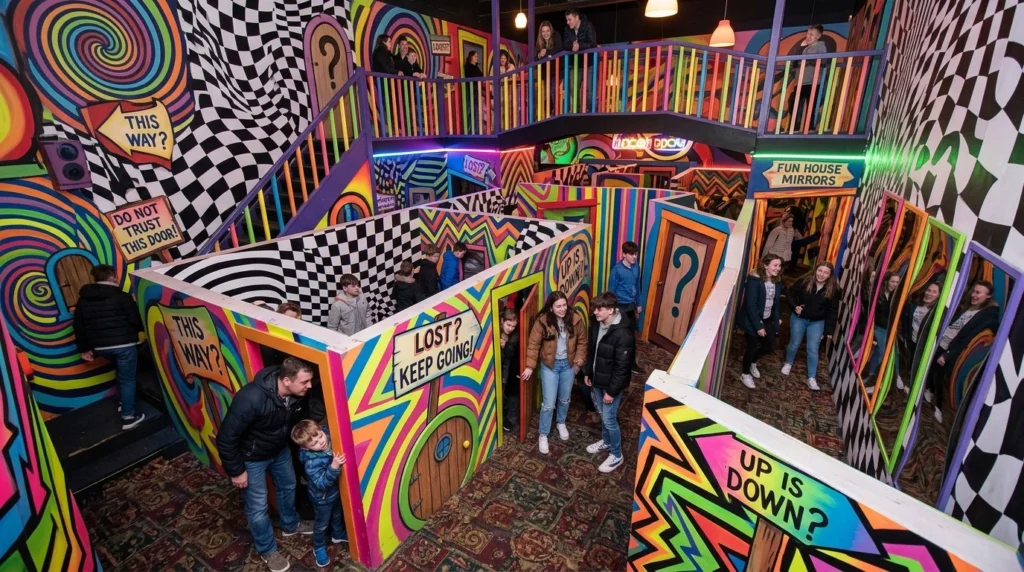
Fun houses are interactive carnival and amusement park attractions designed to disorient, entertain, and delight visitors through sensory illusions. Featuring optical tricks, moving floors, mirrors, and spinning barrels, these classic walkthrough mazes challenge your balance and perception, creating unforgettable laughter and playful excitement for guests of all ages.
Have you ever walked into a room where up felt like down, and your reflection looked like a giant pancake? That is the chaotic, wonderful magic of fun houses working their charm on your senses.
These colorful attractions have been making people laugh and stumble for over a century. Whether you remember walking through one at a local county fair or you are planning your first trip, there is something endlessly fascinating about a house built entirely for play.
Let us take a walk through the swirling barrels, slanted hallways, and mirror mazes to see what makes fun houses such a timeless piece of global entertainment.
What Exactly Is a Fun House?
At its core, a fun house is an interactive walkthrough attraction designed to mess with your balance and perception. Unlike roller coasters that strap you in, these walkthrough mazes let you move at your own pace through a series of playful physical challenges.
You walk through shifting corridors, dodge soft obstacles, and try your best to stay standing on moving floors. The entire goal is simple: to make you feel like a kid again by turning normal physics upside down.
While traditional haunted houses rely on dark hallways and jump scares to make you scream, fun houses focus entirely on joyful confusion and physical humor.
The Core Elements of Classic Walkthroughs
Inside every great fun house, you will find a mix of mechanical devices and visual tricks designed to keep you guessing.
- Distorted Mirrors: Curved glass panels that stretch, shrink, or twist your body into silly shapes.
- Moving Floorboards: Motorized platforms that move up and down or slide side to side as you try to walk across.
- Rotating Barrels: Massive wooden or metal cylinders that turn slowly, testing your balance as you walk through the middle.
- Air Jets: Unexpected gusts of air from the floor that startle walkers and create funny moments.
- Slippery Slides: Spiral chutes that provide a fast and thrilling exit at the very end of the attraction.
The Surprising History Behind Carnival Fun Houses
The story of the modern fun house begins in the late 19th century during the rise of seaside amusement parks. Coney Island in New York became the epicenter for innovative mechanical entertainment that quickly captured the world’s imagination.
Early creators realized that people loved testing their physical limits in a safe and silly environment. The very first attractions were simple wooden structures filled with simple ramps and tricks.
Over time, travelling carnivals adopted portable versions of these walkthroughs, bringing the excitement directly to towns across North America and Europe.
From Coney Island to Global Pop Culture
The Coney Island “Steeplechase Park” introduced early concepts like the “Human Roulette Wheel” and sliding stairs in the early 1900s. These wild mechanical creations paved the way for dedicated walkthrough buildings.
As circus troupes and travelling fairs grew popular, builders began crafting modular fun houses mounted on semi-truck trailers. This innovation made it easy to fold up a two-story building and drive it to the next city in a single night.
Today, you can find classic wooden walkthroughs in historic parks alongside ultra-modern, computer-controlled fun houses at major international theme parks.
How Fun Houses Trick Your Brain and Body
Have you ever wondered why walking down a tilted hallway makes you feel dizzy right away? It all comes down to how your brain processes visual cues and internal balance.
Your inner ear relies on gravity to figure out which direction is straight down. When a room is built on an incline, your eyes tell your brain the room is level, but your inner ear disagrees completely.
This sudden conflict between sight and sensation creates a temporary sense of vertigo that feels exciting rather than dangerous.
The Science of Optical Illusions
Optical illusions play a huge role in guiding you through a fun house maze. By painting walls with sloping lines or alternating geometric patterns, designers can fool your vision instantly.
When visual lines do not line up with the physical floor, your brain gets confused about distance and depth. You might think a door is ten feet away when it is actually right in front of your face.
This clever trickery forces you to slow down, put out your hands, and laugh as your instincts attempt to figure out the space.
Why Your Feet Fail You on Moving Floors
Balance requires steady feedback from your feet, muscles, and eyes. Mechanical fun houses disrupt all three systems simultaneously using moving floorboards.
When the ground beneath you moves laterally or tilts without warning, your automatic reflexes kick in to save you from falling. Because the motion is constant and unpredictable, you end up doing a hilarious, clumsy shuffle across the bridge.
The secret to conquering these floors is staying light on your toes and keeping your knees slightly bent as you step forward.
Inside the Design: Architectural Tricks and Secrets
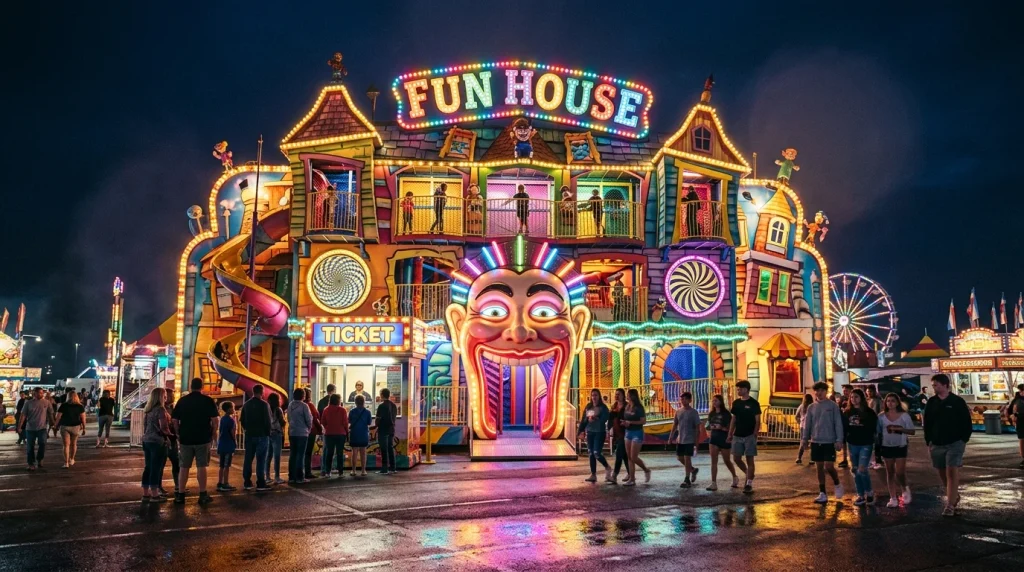
Designing a successful fun house requires a rare mix of mechanical engineering, architectural creativity, and crowd psychology. Builders must craft an environment that feels unpredictable while keeping thousands of visitors completely safe each day.
Every turn, hallway, and drop is carefully calculated to guide the flow of people smoothly from start to finish.
Classic Attractions and How They Fool You
Here is a breakdown of the most famous walkthrough features and how they work their magic on your brain:
- Hall of Mirrors: Uses high-quality reflective glass placed at precise angles to create infinite light reflections, turning navigation into a funny challenge of visual distortion.
- Vortex Tunnel: Employs a rotating visual cylinder around a solid bridge to give you the sudden illusion of falling or flipping upside down.
- Slanted Room: Built with deliberately angled walls and floors to disrupt your gravity sensors and cause a harmless loss of balance.
- Squeezing Wall Alley: Features soft inflatable barriers that hug your body, offering a playful tactile obstacle you have to squeeze through.
Crafting the Hall of Mirrors
The Hall of Mirrors is arguably the most famous section of any walkthrough attraction. Builders place high-quality reflective glass at precise 60-degree or 90-degree angles to create endless hallways.
Because you cannot see where the real pathway turns, you end up staring at dozens of reflections of yourself stretching into infinity.
To avoid bumping your nose against the glass, most operators encourage you to walk slowly with your hands outstretched in front of you.
Building the Rotating Vortex Tunnel
The vortex tunnel is a modern marvel of sensory illusion that leaves almost every guest giggling or gripping the handrails for dear life.
You walk across a stable, completely stationary metal bridge while a massive painted cylinder rotates rapidly all around you.
Even though your feet are firmly planted on solid ground, your brain trusts the motion of the spinning walls around you, making you feel like the walkway itself is flipping over.
Popular Types of Fun Houses Around the World
Not all walkthrough attractions are built the same way. Depending on where you go, you will encounter distinct styles ranging from rustic retro carnivals to high-tech digital labyrinths.
Understanding these variations helps you choose the right experience for your friends and family.
Classic Traveling Fair Walkthroughs
These are the portable, multi-level units seen at local fairs, town festivals, and carnivals every summer. They pack a surprising number of physical obstacles into a compact footprint.
- Features: Punching bags, sliding staircases, short mirror mazes, and outdoor spiral slides.
- Vibe: High energy, fast-paced, nostalgic, and loud.
- Best For: Kids, teenagers, and families looking for quick carnival thrills.
Permanent Amusement Park Walkthroughs
Located inside established theme parks, these permanent attractions feature larger footprints, detailed thematic decoration, and complex mechanical systems.
- Features: Deep storylines, custom animated props, massive indoor mirror mazes, and climate-controlled rooms.
- Vibe: Immersive, highly detailed, atmospheric, and comfortable.
- Best For: Theme park fans who love detailed environments and classic nostalgia.
Modern Immersive and Digital Mazes
The newest generation of fun houses uses modern projection mapping, interactive touch panels, and responsive laser networks to rethink the traditional maze.
- Features: Infinite LED light tunnels, reactive floors, dynamic infinity rooms, and sound-reactive art installations.
- Vibe: Futuristic, photogenic, surreal, and artistic.
- Best For: Young adults, photographers, and fans of modern digital art.
Safety First: How Modern Fun Houses Keep You Safe

While fun houses are built to feel wild and chaotic, modern units are held to strict safety and engineering standards. Behind the scenes, operators focus heavily on visitor safety so everyone leaves with great memories.
Emergency lighting systems, non-slip floor mats, padded wall corners, and clear exits are standard features in modern setups.
Attendants monitor high-traffic zones using closed-circuit cameras to ensure guests move through safely without crowding.
Practical Safety Tips for Visitors
To have the best possible time inside any walkthrough, follow these simple safety guidelines:
Footwear Matters
Always wear comfortable, flat, closed-toe shoes like sneakers. Avoid wearing high heels, flip-flops, or loose sandals that can easily slip off on moving floorboards.
Watch Your Step
Take your time walking through dark areas or mirror sections. Running inside a glass maze can easily lead to bumped knees or bruised foreheads.
Keep Your Hands Free
Store loose items like hats, sunglasses, and valuable phones securely in your pockets or a small bag so you can hold handrails easily.
Why We Love Being Fooled: The Psychology of Fun
Why do human beings pay money to get disoriented, walk into glass, and struggle to keep their balance on moving floors? The answer lies in psychology and play behavior.
When you enter a fun house, you enter a safe, controlled environment where normal social rules disappear. It is one of the few places where adults are encouraged to stumble, laugh out loud, and play like children.
The light stress of losing your balance releases dopamine and endorphins, turning mild confusion into pure joy.
Bonding Through Shared Laughter
Walking through an obstacle-filled house with friends or family creates an instant connection through shared laughter. Watching a friend struggle to walk across a tilting floor or get lost in a mirror maze breaks down awkwardness immediately.
These shared, silly moments become funny stories that friends remember and talk about for years after the visit.
Planning Your Next Visit: Tips for the Best Experience
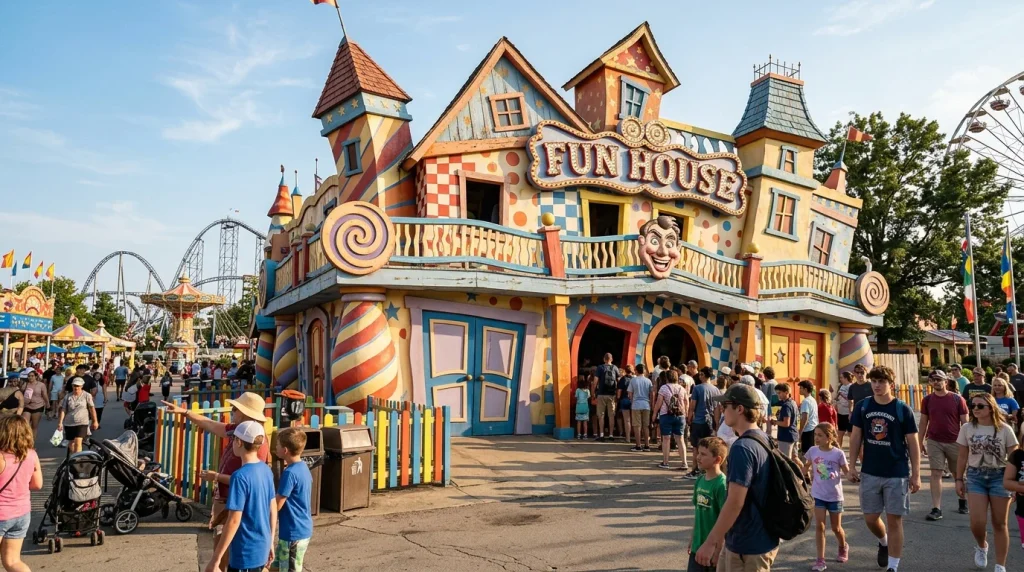
Ready to head out and test your balance at an attraction near you? A little preparation can turn a good trip into an unforgettable day.
Whether you are going with young kids or a group of adult friends, timing and preparation make all the difference.
Best Times to Go
Try visiting during weekday mornings or early afternoons when lines are short. Fewer crowds inside mirror mazes give you more space to explore without feeling rushed by people behind you.
What to Bring
Travel light! Bring only essential items like your wallet, keys, and phone secured in zippered pockets. Avoid carrying large backpacks that can catch on narrow doorframes or inflatable obstacles.
Age Considerations
Check height and age rules before lining up with small toddlers. While most sections are family-friendly, dark hallways or intense spinning tunnels can sometimes startle very young kids.
MCQs
Test your knowledge about fun house secrets, mechanics, and history with this quick quiz!
1. What is the primary purpose of a classic rotating vortex tunnel?
A. To make visitors drop their personal items
B. To create a visual illusion that disrupts your balance
C. To dry off visitors after a water ride
D. To move visitors quickly to the next floor
2. Which feature is most commonly used to twist and deform a visitor’s visual reflection?
A. Flat glass panels
B. Polarized plastic sheets
C. Curved distorted mirrors
D. Opaque acrylic boards
3. Why do slanted rooms make people feel dizzy?
A. The air pressure drops suddenly
B. Visual cues conflict with the inner ear balance system
C. The temperature is kept colder than normal
D. The floors are coated with slippery wax
4. Which famous amusement area played a massive role in early fun house history in the early 1900s?
A. Blackpool Pleasure Beach
B. Coney Island
C. Tivoli Gardens
D. Cedar Point
Part Two
5. What type of footwear is best for navigating moving floorboards safely?
A. High heels
B. Flip-flops
C. Flat, closed-toe sneakers
D. Loose slip-on sandals
6. What sensory system does the inner ear control inside a fun house?
A. Taste perception
B. Balance and spatial orientation
C. Visual clarity
D. Touch sensitivity
7. How do designers prevent people from bumping into mirror maze walls?
A. They turn off all the lights inside
B. They post guards at every mirror
C. They encourage guests to walk slowly with hands outstretched
D. They cover all mirrors with dark curtains
8. What makes modern immersive mazes different from traditional fair walkthroughs?
A. They do not allow any visitors inside
B. They rely heavily on digital lights, lasers, and projections
C. They only use wooden floorboards
D. They are built inside water pools
9. What is the main structural benefit of a mobile fair fun house mounted on a trailer?
A. It never requires electrical power
B. It can be folded up and transported easily between towns
C. It holds up to ten thousand people at once
D. It does not need any safety inspections
10. Why do people enjoy the psychological confusion inside a fun house?
A. It triggers safe, thrilling releases of dopamine and endorphins
B. It helps improve long-term mathematical memory
C. It cures motion sickness permanently
D. It replaces the need for sleep
Answer Key
- B
- C
- B
- B
- C
- B
- C
- B
- B
- A
FAQs
What makes fun houses different from haunted houses?
Fun houses focus on joyful entertainment, light physical obstacles, and optical tricks designed to make you laugh. Haunted houses use dark corridors, scary monsters, and sudden jump scares to create fear. Both offer thrilling walkthroughs, but their underlying mood and goal are completely different.
Are fun houses safe for young children?
Yes, most fun houses are safe and designed specifically for family entertainment. However, very young children might find dark corridors or spinning tunnels a bit overwhelming. Parents should hold hands with young kids and guide them gently through challenging moving sections.
How long does it take to walk through a typical fun house?
A walk through a standard carnival walkthrough takes about 5 to 10 minutes from start to finish. Larger indoor theme park attractions or digital mirror mazes can take 15 to 20 minutes, depending on how quickly you navigate the maze.
What should I do if I feel dizzy inside a vortex tunnel?
If a rotating tunnel makes you feel dizzy, simply close your eyes or focus your vision straight down on the stable footbridge. Your balance will recover almost instantly once your eyes stop tracking the spinning walls around you.
Can people with claustrophobia enjoy walkthrough mazes?
Many people with mild claustrophobia enjoy open multi-level units without issue. However, if narrow passages or dark mirror mazes make you anxious, ask the entrance attendant about the layout before purchasing your ticket to ensure you feel comfortable.
Do modern fun houses have weight or height limits?
Some mechanical obstacles, spiral slides, or multi-story ladders have minor height or weight guidelines for guest safety. These rules are posted clearly near the ticket booth at the front entrance of the attraction.
Conclusion
Fun houses remain one of the most beloved traditions in physical entertainment because they bring pure, simple joy to people of all ages. From classic mirrors to futuristic light mazes, these clever structures remind us how much fun it is to laugh at ourselves.
The next time you visit a local carnival, state fair, or theme park, do not just walk past that colorful facade. Step inside, embrace the dizzying twists, hold onto the handrails, and let yourself enjoy the magic of play.
Have you explored a great walkthrough maze recently? Grab your friends, wear your most comfortable sneakers, and head out to experience the silly charm of fun houses for yourself today!

Asjad Ali is a passionate, fun, and entertainment enthusiast who enjoys discovering interesting, amusing, and engaging content from around the web. Through laughvista.com, Asjad shares lighthearted ideas, entertaining stories, fun facts, jokes, and enjoyable content designed to bring a little more laughter and positivity into everyday life. His goal is to create content that feels natural, relatable, and easy for everyone to enjoy.
With a genuine interest in fun and entertainment, Asjad Ali focuses on creating friendly content for readers of different ages and backgrounds. laughvista.com is built around the idea that a few moments of laughter can brighten anyone’s day. Whether readers are looking for something funny, interesting, or simply entertaining, Asjad aims to make every visit enjoyable, refreshing, and worth coming back to.