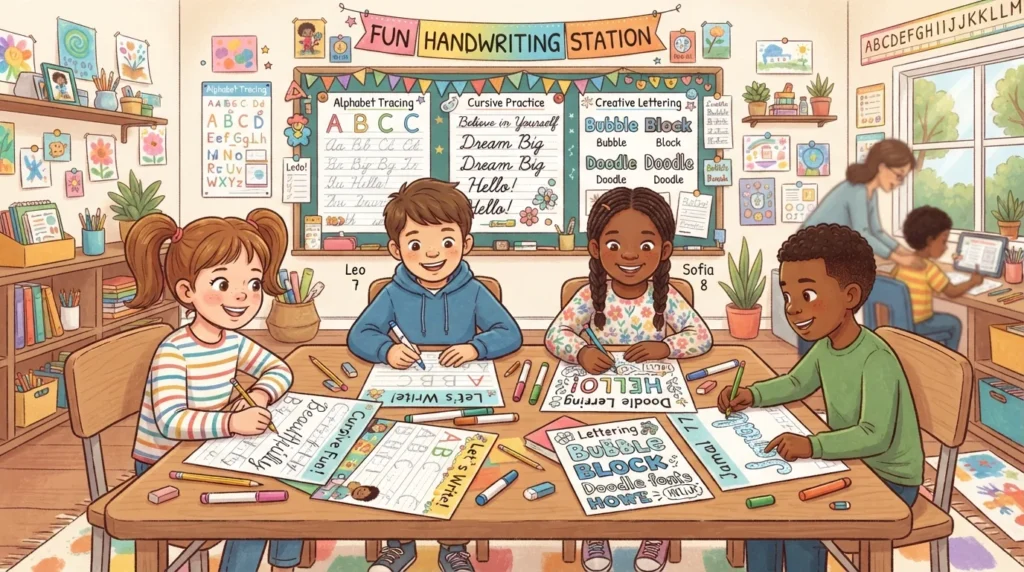
Fun handwriting is the creative practice of styling your daily penmanship using playful fonts, decorative flourishes, and vibrant layouts. Unlike traditional cursive, fun handwriting focuses on self-expression, personality, and visual flair while keeping your notes, journals, and artistic projects easy to read and enjoyable to create.
Have you ever looked at a handwritten menu or a bullet journal page and wondered how someone made plain letters look so alive?
You do not need to be a born artist to master fun handwriting in your everyday notes.
With just a few basic tricks and a regular pen, you can transform simple alphabet shapes into playful, eye-catching letter designs.
What Makes Fun Handwriting So Special?
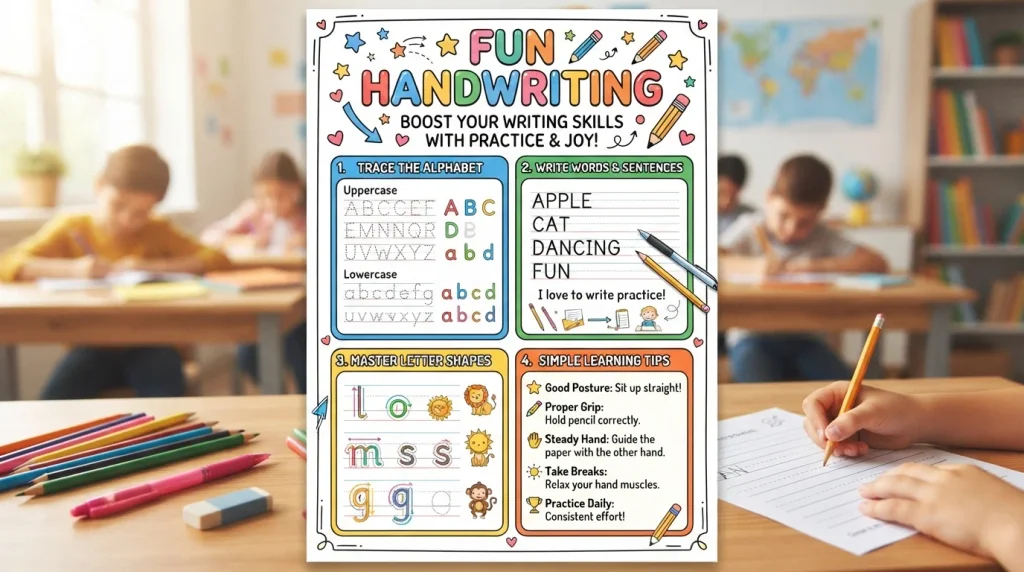
Handwriting is far more than just a way to spill information onto a blank sheet of paper.
When you focus on fun handwriting, you turn an ordinary task like making a shopping list into a cozy creative outlet.
It lets you slow down, enjoy the movement of your hand, and add a touch of color to your daily routine.
Breaking Free from Old School Rules
Remember sitting in grade school trying to trace perfect cursive lines over and over?
Standard penmanship focuses heavily on strict rules, continuous slants, and rigid letter shapes.
Fun handwriting throws those strict boundaries out the window and lets you experiment with dynamic spaces, bold loops, and quirky character sizes.
The Mental Health Benefits of Playful Lettering
Taking time to work on fun handwriting acts as a wonderful, screen-free mindfulness break.
Focusing on smooth pen strokes helps lower your stress after a long, noisy day.
It activates the visual parts of your brain while giving your hands something tactile and satisfying to build.
Essential Tools to Get Started
You do not need to drop a small fortune on high-end art supplies to practice fun handwriting.
In fact, starting with simple items found around your house often works best.
Simple Everyday Pens
Standard ballpoint pens, gel pens, and fine-liners are perfect tools for beginners.
Gel pens slide smoothly across paper, which makes drawing curved letters effortless.
Fine-liners give you crisp lines that keep your custom lettering clean and sharp.
Choosing the Right Paper
Smooth paper prevents your ink from bleeding across the page or catching on the pen tip.
Dotted grid journals are exceptionally helpful because the tiny dots guide your letter heights.
Plain printer paper works great for quick warmth drills and casual daily practice.
Fun Extras for Creative Flair
Highlighters, colored markers, and brush pens add instant depth to your written designs.
You can use soft pastel markers to underline key terms or shade behind your main words.
Washi tape and simple ruler lines can also help structure your overall layout nicely.
Basic Building Blocks of Fun Handwriting
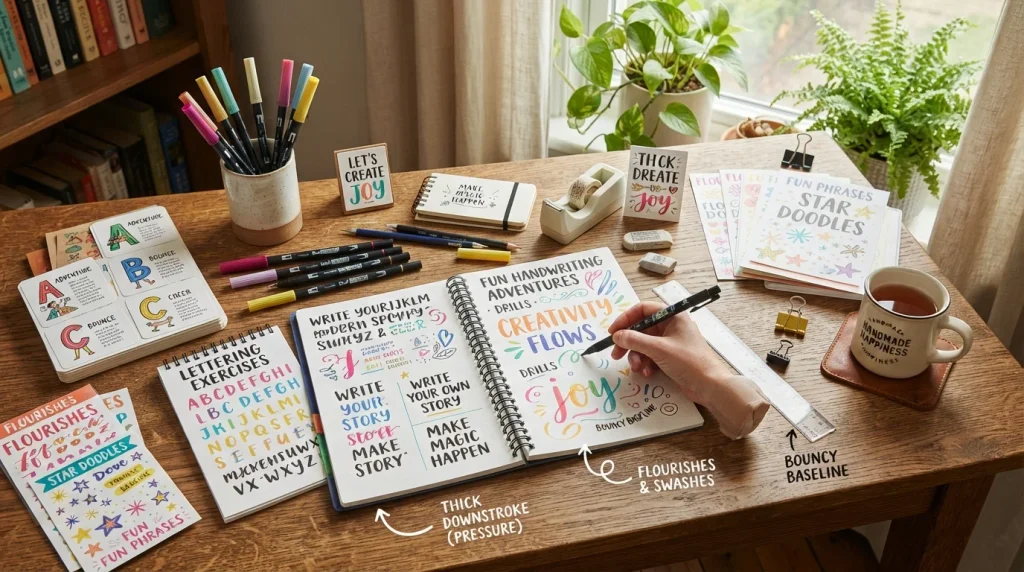
Before diving into complex styles, let us look at the fundamental elements of fun handwriting.
By tweaking just one or two basic elements, you can create dozens of distinct alphabet looks.
Letter Height and Spacing
Changing the height of your letters dramatically alters how your writing looks on paper.
Try drawing the tops of your letters tall while keeping the lower loops very short.
Spacing your letters wider apart instantly gives your page a modern, airy feel.
Playful Slants and Angles
Traditional penmanship requires a consistent rightward slant for every single character.
With fun handwriting, you can tilt letters slightly forward, keep them perfectly vertical, or alternate angles for a bouncy look.
Mixing straight vertical lines with oversized round curves brings instant energy to headers.
Line Thickness Variations
Controlling how thick or thin your lines are creates a bold visual contrast.
Thicker downstrokes give your words structure, while delicate upstrokes add lightness.
Even simple faux calligraphy tricks can make standard printing look like expensive brush work.
5 Easy Styles of Fun Handwriting to Try Today
Here are five beginner-friendly styles of fun handwriting that you can start using right away.
1. Bouncy Bubble Print
Bubble print is cheerful, rounded, and full of personality.
To draw bubble letters, trace soft curves around your standard print shapes, leaving plenty of empty space inside.
You can leave the centers white or fill them in with bright colors.
2. Faux Calligraphy
Faux calligraphy lets you achieve the elegant look of real calligraphy using standard pens.
Write out your text in simple script, then draw a second parallel line on every downward pen stroke.
Fill in those double-lined gaps with solid ink to create rich, dramatic contrasts.
3. Quirky Tall Sans-Serif
This style uses elongated vertical lines and tiny, compact letter centers.
Draw your letters as tall and narrow as possible while keeping horizontal strokes high up on the stem.
It looks clean, modern, and fits nicely into narrow journal margins.
4. Playful Block Letters
Block letters use straight edges and sharp corners to make strong statements.
You can draw them thick, add drop shadows, or fill them with small diagonal stripes.
They are ideal for bold headers, cover pages, and important study notes.
5. Whimsical Loop Cursive
Loop cursive blends regular cursive writing with exaggerated, looping loops on letters like “y,” “g,” and “l.”
Make the top and bottom loops twice as large as the middle letter bodies.
This creates a breezy, artistic script that flows smoothly across the page.
Quick Comparison of Fun Handwriting Styles
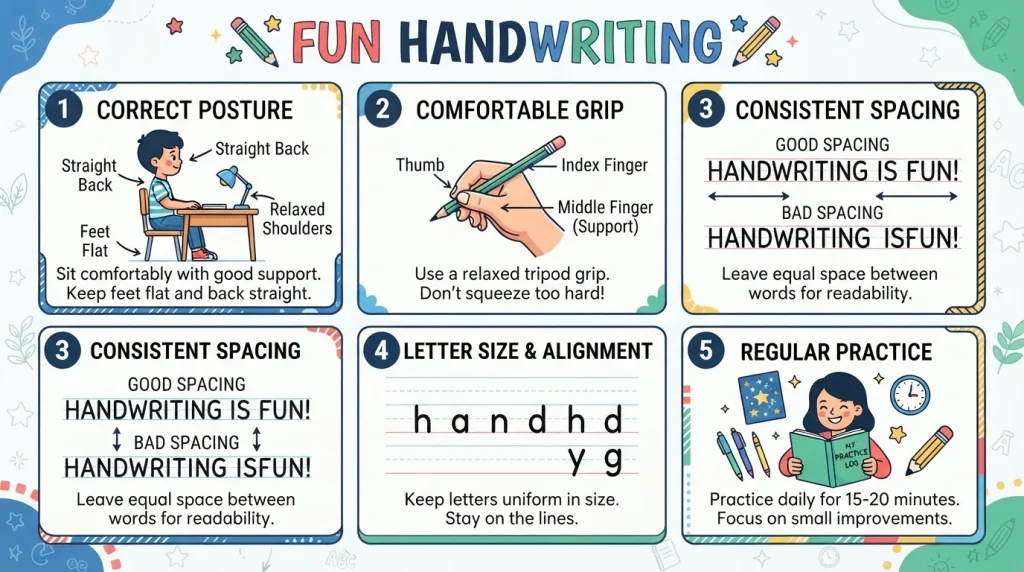
Each fun handwriting style brings its own unique flavor, rhythm, and purpose to the page. Whether you want to make a bold statement, keep things organized in a tight space, or add an elegant touch to a personal note, choosing the right style depends entirely on what you are creating. By combining different difficulty levels and pen types, you can easily mix and match these styles to give your bullet journals, study guides, and greeting cards an eye-catching, handcrafted look.
Matching Styles to Your Creative Projects
Not all lettering styles serve the same purpose on a page. Bold, rounded styles like Bouncy Bubble Print and Playful Block Letters are ideal for grabbing attention in titles, banners, and cover pages. On the other hand, compact designs like Quirky Tall Sans-Serif excel in tight margins or daily task lists where space is limited. Selecting the right style for your specific project ensures your page stays readable while still looking beautifully artistic.
Choosing the Right Tools for Every Script
The pen you choose plays a massive role in how smoothly your handwriting turns out. Standard ballpoints and fine-liners give you precise control for detailed styles like Quirky Tall Sans-Serif or Faux Calligraphy outlines. However, if you are working with large block letters or bubble fonts, broader markers, liquid ink pens, or chisel-tip highlighters help you fill in shapes quickly without tearing through your paper.
Blending Multiple Styles for Visual Impact
One of the best ways to elevate your overall layout is by combining two contrasting styles in a single design. Pairing a clean, tall print with a flowing Whimsical Loop Cursive or high-contrast Faux Calligraphy creates instant emphasis and hierarchy. This technique naturally guides the reader’s eye toward your most important headers and key terms, turning plain text into an engaging visual experience.
Step-by-Step Guide to Faux Calligraphy
Faux calligraphy is the single easiest entry point into the world of decorative lettering.
Step 1: Write Your Base Word
Start by writing your target word in loose, spaced-out cursive or neat print using a fine-liner.
Leave slightly more space between each letter than you normally would.
This extra breathing room ensures your thicker strokes will not overlap awkwardly later.
Step 2: Identify Your Downstrokes
Think about the exact direction your pen traveled while forming each letter.
Every time your pen moved toward the bottom of the page, that line is a downstroke.
Upward movements and horizontal connecting lines are upstrokes and should stay thin.
Step 3: Outline the Thickness
Draw a secondary line next to every downstroke line you identified in the previous step.
Keep the space between the original stroke and your new line consistent across all letters.
Make sure the top and bottom of your new outline taper back smoothly into the original line.
Step 4: Fill in the Gaps
Color in the enclosed spaces between your twin lines using the same pen.
Now your plain print transforms into stylish, high-contrast faux calligraphy!
You can also try filling the gaps with dots or stripes instead of solid ink.
How to Add Creative Decor to Your Letters
Once you know basic letter shapes, adding tiny decorative accents elevates your design work instantly.
Adding Drop Shadows
Drop shadows give your words a dramatic three-dimensional effect that pops right off the page.
Imagine a soft light shining down from the top-left corner of your notebook.
Draw thin dark lines along the right side and bottom edges of every letter to simulate realistic depth.
Incorporating Little Doodles
Weaving tiny illustrations directly into your words makes fun handwriting extra charming.
You can replace the dot on the letter “i” with a small star, heart, or tiny flower blossom.
Loop the tail of the letter “g” or “y” into a sweet ribbon design or hanging leaf stem.
Playing with Color Blends and Highlights
Adding bright color contrasts instantly boosts the overall visual energy of your handwriting project.
Write your text in dark ink first, then lay a soft pastel highlighter band straight across the middle of the words.
You can also use a white gel pen to add sharp shine dots inside thick downstrokes.
Practical Ways to Use Fun Handwriting Every Day
You do not need to sit down for hours of formal practice to enjoy decorative lettering.
Integrating fun handwriting into your regular day makes ordinary writing tasks feel special.
Upgrading Bullet Journals and Planners
Bullet journals offer the ultimate canvas for testing new letter styles and creative layouts.
Use bold block letters for monthly title pages and smooth faux calligraphy for weekday headers.
Quirky tall print works brilliantly for daily task lists where space is tight.
Hand-Crafting Custom Gift Cards
A personal, hand-lettered message turns simple cardstock into a memorable keepsake.
Combine a bouncy bubble font with bright drop shadows to craft cheerful birthday wishes.
Your friends will appreciate the care and personal touch embedded in your custom script.
Making Study Notes Readable and Engaging
Studying complex topics becomes far less boring when your study guides look visually organized.
Use fun handwriting to create high-impact section headings that stand out during quick review sessions.
Changing styles between major topics helps your memory organize and retain information better.
Overcoming Common Beginner Challenges
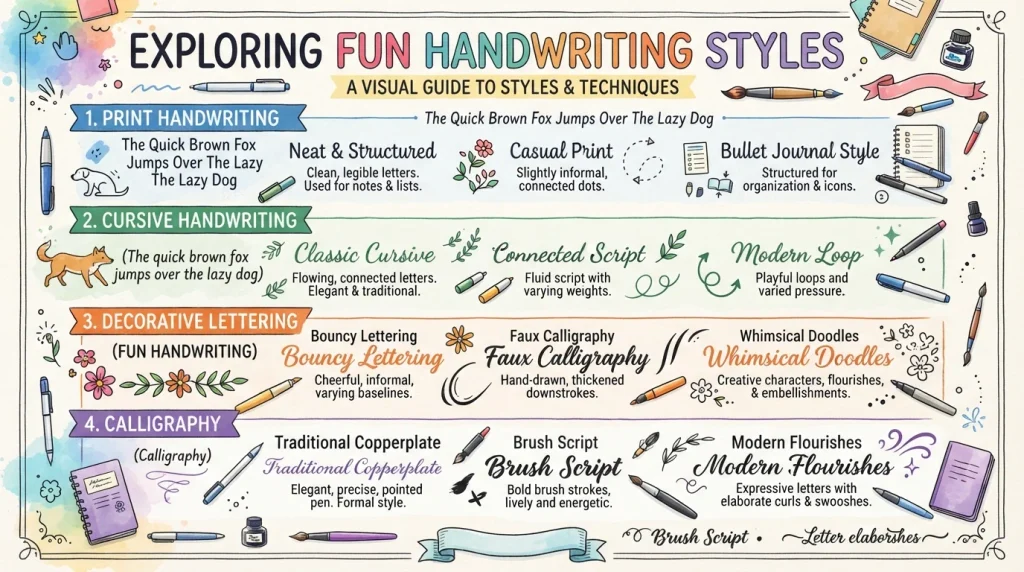
Starting any new creative skill can feel a bit intimidating at first, but small adjustments fix most issues.
Dealing with Unsteady Hands
If your line work looks shaky, check your grip and check how hard you press down.
Holding your pen too tightly causes hand tension, which leads directly to wobbly strokes.
Relax your fingers, breathe out, and pull your strokes using your arm muscle movement instead of just your wrist.
Fixing Uneven Letter Spacing
Uneven spacing between letters can make even beautiful fonts look messy and hard to read.
Lightly pencil in guideline boxes or use dot-grid paper to establish consistent widths.
Remember that rounded letters like “O” can sit closer to straight letters like “I” than two straight letters can.
Preventing Smudged Ink
Nothing ruins a fresh page faster than a hand dragging across wet ink lines.
If you write with your left hand, try working from right to left across your decorative designs where possible.
Choose quick-drying fine-liners or gel pens that set instantly on smooth paper stock.
Simple Daily Practice Routines
Consistent practice is the true secret to developing confident, fluid handwriting habits.
Spending just five minutes a day yields far better results than practicing for hours once a month.
The 5-Minute Warm-Up Routine
Before writing full words, warm up your hand by drawing simple geometric shapes on scratch paper.
Fill a few lines with continuous loops, straight vertical lines, and repeating S-curves.
This simple exercise builds muscle memory and loosens up stiff finger joints.
Alphabet Tracing and Variations
Pick one specific style of fun handwriting and write out the entire alphabet from A to Z.
Focus on keeping the height and slant of each character visually consistent throughout the sequence.
Try rewriting the exact same alphabet again, but this time change the heights of all the crossbars.
Lettering Favorite Quotes
Choose a short, positive quote that makes you smile and write it out using two contrasting styles.
Use clean tall print for the minor connecting words and bold faux calligraphy for the key impact words.
Playing with layout scale keeps your daily practice fun and deeply rewarding.
Practice Exercise
1. What does handwriting refer to?
A) Writing by hand
B) Typing on a computer
C) Printing photographs
D) Drawing with paint
2. Which tool is commonly used for handwriting?
A) Pen
B) Spoon
C) Ruler only
D) Camera
3. What can make handwriting more attractive?
A) Creative lettering
B) Random marks
C) Unclear spacing
D) Missing letters
4. Why is spacing important in handwriting?
A) It improves readability
B) It makes paper heavier
C) It changes ink color
D) It removes punctuation
5. Which handwriting style focuses on decorative letters?
A) Calligraphy
B) Typing
C) Coding
D) Photography
6. What can regular handwriting practice improve?
A) Writing skills
B) Shoe size
C) Screen brightness
D) Room temperature
7. Which surface is commonly used for handwriting practice?
A) Paper
B) Glass window only
C) Metal wall
D) Plastic bottle
8. What is cursive handwriting known for?
A) Connected letters
B) Only capital letters
C) Numbers without words
D) Printed photographs
9. Which item can help children practice fun handwriting?
A) Tracing worksheets
B) Cooking utensils
C) Sports equipment
D) Musical speakers
10. What is an important quality of good handwriting?
A) Legibility
B) Randomness
C) Excessive decoration
D) Tiny unreadable letters
Answer Key
1-A | 2-A | 3-A | 4-A | 5-A | 6-A | 7-A | 8-A | 9-A | 10-A
FAQs
Do I need good natural handwriting to do fun handwriting?
No prior good handwriting is required to start enjoying decorative lettering. Fun handwriting relies on deliberate drawing techniques and basic shapes rather than fast, natural penmanship. With simple practice tricks like faux calligraphy, anyone can draw beautiful words regardless of their everyday messy notes.
What is the best pen for a complete beginner?
A simple fine-liner pen with a 0.5mm tip is ideal for beginners. Fine-liners produce clean, dark lines that do not bleed easily across standard paper. They give you complete control over your strokes while you learn basic letter sizing and decorative outline techniques.
How do I stop my ink from smudging while I write?
To stop smudging, select fast-drying fine-liner pens or standard ballpoints instead of slow-drying gel inks. Place a clean sheet of scrap paper under your writing hand to catch oil and friction. Working slowly from top to bottom also protects fresh lines.
Can left-handed writers enjoy fun handwriting easily?
Left-handed writers can absolutely master fun handwriting with a few basic adjustments. Angle your paper slightly to the right to keep your hand underneath your writing line. Using quick-drying fine-liners ensures your hand slides over dry paper without dragging wet ink.
How often should I practice to see real progress?
Practicing just 5 to 10 minutes every day yields quick, visible improvements in line control. Short, consistent practice sessions build hand muscle memory far more effectively than long, exhausting sessions spaced weeks apart. Keep scratch paper near your desk for quick daily drills.
What is faux calligraphy compared to real brush lettering?
Faux calligraphy imitates the look of brush lettering by manually drawing double lines on downstrokes using standard pens. Real brush lettering relies on applying varied physical pressure with flexible brush tips. Faux calligraphy offers far more control for absolute beginners learning letter structures.
How do I make my letter spacing look balanced?
Maintain consistent spacing by treating the open gaps between letters like tiny water drops. Curved letters like “O” can sit closer together, while straight letters like “H” need more breathing room. Using light pencil guides or dot-grid paper helps keep spacing uniform.
Conclusion
Developing your own style of fun handwriting is a satisfying journey that brings everyday creativity to life.
You do not need expensive art kits or natural talent to make your words look lively and unique.
With simple tricks like bouncy spacing, bold drop shadows, and faux calligraphy, your plain notes can instantly become colorful visual art.
Grab a simple fine-liner, open a fresh notebook page, and start playing with basic letter shapes today.
Enjoy every wobble, flourish, and loop as you build confidence in your craft.
With just a few minutes of daily practice, you will discover that fun handwriting makes every list, note, and card a joy to create.

Asjad Ali is a passionate, fun, and entertainment enthusiast who enjoys discovering interesting, amusing, and engaging content from around the web. Through laughvista.com, Asjad shares lighthearted ideas, entertaining stories, fun facts, jokes, and enjoyable content designed to bring a little more laughter and positivity into everyday life. His goal is to create content that feels natural, relatable, and easy for everyone to enjoy.
With a genuine interest in fun and entertainment, Asjad Ali focuses on creating friendly content for readers of different ages and backgrounds. laughvista.com is built around the idea that a few moments of laughter can brighten anyone’s day. Whether readers are looking for something funny, interesting, or simply entertaining, Asjad aims to make every visit enjoyable, refreshing, and worth coming back to.