
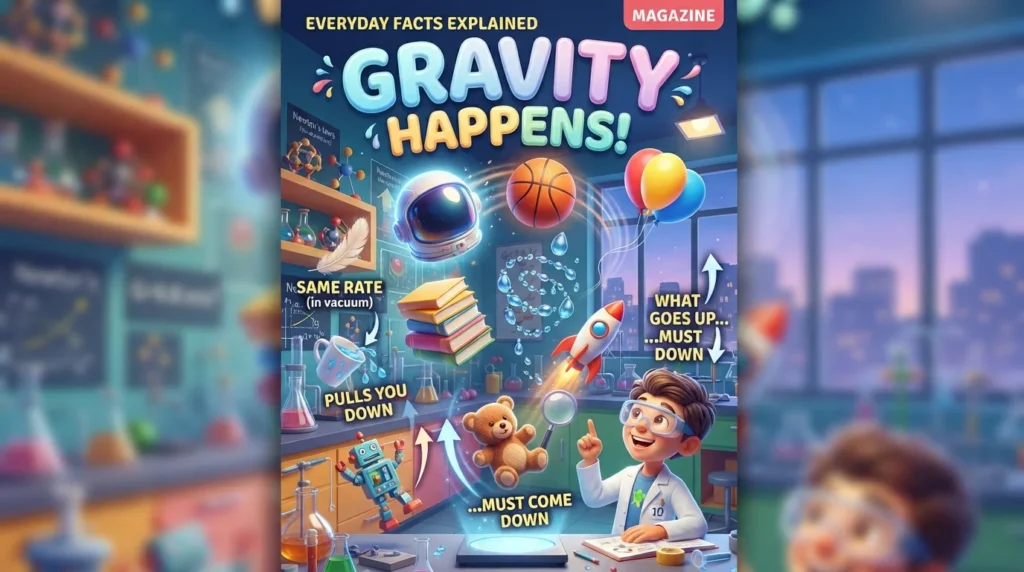
Gravity is an invisible force that pulls objects toward each other, holding our world together. It keeps your feet planted on Earth, guides the moon around our planet, and keeps Earth orbiting the sun. Without it, atmosphere, oceans, and life as we know it simply could not exist.
Have you ever wondered why you do not float off into space when you jump? Exploring fun gravity facts reveals how this invisible force shapes everything around us.
Gravity is the silent power keeping your feet on the ground and holding the entire universe together. Learning these fun gravity facts makes science feel like an exciting adventure.
Let us explore the wild ways this mystery force works on Earth and far beyond!
What Is Gravity and How Does It Actually Work?
Gravity acts like an invisible tether pulling physical objects toward one another. Every piece of matter in the universe possesses this attracting force.
The strength of this pulling power depends directly on mass and distance. Bigger objects pull harder, while greater distance weakens the connection.
The Invisible Magnet of the Cosmos
Imagine holding a giant bowling ball on a stretchy trampoline. The heavy ball creates a deep dip in the middle.
If you roll a small marble across the surface, it curves toward the heavy ball. Space works in a very similar way.
Massive celestial bodies bend the fabric of space around them. That curvature guides the paths of smaller surrounding objects.
Mass Versus Weight: What Is the Real Difference?
Many people use mass and weight as if they mean the same thing. However, physics separates them into two distinct ideas.
Your mass represents the total amount of matter inside your body. That measurement stays identical no matter where you travel in space.
Your weight measures how hard gravity pulls down on your mass. If you stand on a smaller world, your weight changes completely.
Sir Isaac Newton and the Falling Apple Myth
You might have heard the famous story about an apple falling on Isaac Newton’s head. While an apple tree inspired his thinking, it did not hit his head.
Newton observed fruit dropping straight down toward the ground in his orchard. He realized the same force pulling apples also holds the moon in orbit.
That simple observation led to the universal law of gravitation. It changed our understanding of the cosmos forever.
Mind-Blowing Fun Gravity Facts About Earth
Earth provides the perfect gravitational sweet spot for human life to thrive. Our planet’s size creates enough pull to hold atmosphere and water without crushing us.
You Are Slightly Lighter at the Equator
Earth is not a perfectly round sphere like a polished marble. It bulges slightly outward around its middle equator due to spinning.
Because the equator sits farther from Earth’s center, gravity feels slightly weaker there. You actually weigh about 0.5 percent less at the equator than at the poles.
Gravity Is Not Completely Uniform Everywhere
Earth’s interior is not made of identical materials spread evenly throughout. Some regions contain dense iron ore, while others hold deeper ocean basins.
Dense areas exert a slightly stronger gravitational pull than hollow or low-density regions. Scientists map these subtle variations using precision satellites.
Canada’s Hudson Bay region actually has lower gravity than the global average. Part of this stems from ancient ice sheets pressing into Earth’s crust.
High Tides and Low Tides Are Gravity in Action
Ocean tides offer a daily demonstration of cosmic gravitational power. The moon pulls gently on Earth’s vast oceans as it orbits overhead.
This pull creates a bulge of water on the side facing the moon. Another bulge forms on the opposite side due to inertia.
As Earth rotates through these water bulges, coastlines experience regular high and low tides. The sun also contributes to tides, though its great distance reduces its impact.
How Gravity Works Across the Solar System
Every planet in our solar system features a unique strength of gravitational pull. Exploring these differences shows how extreme space can get.
Bouncing Around on the Moon
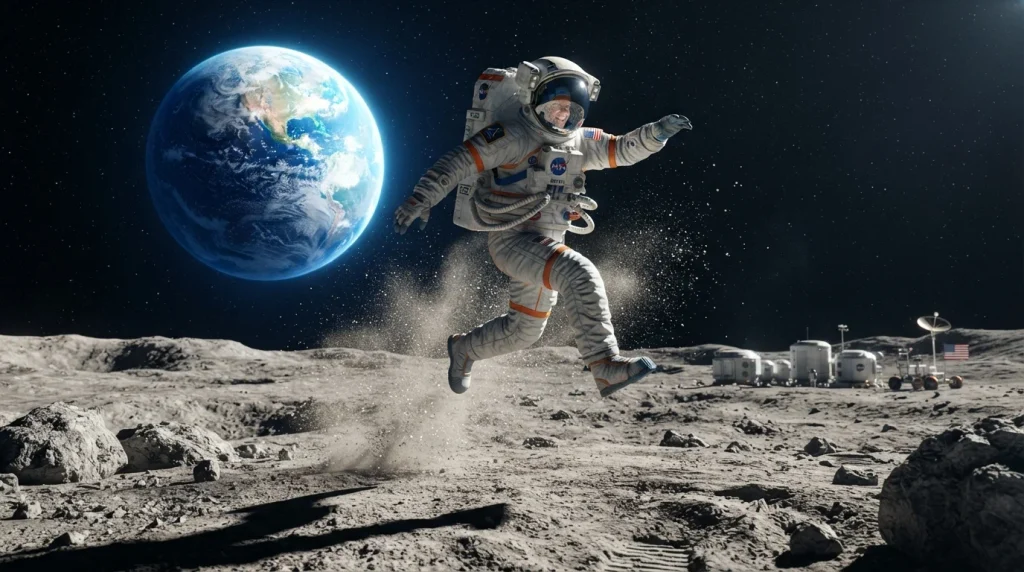
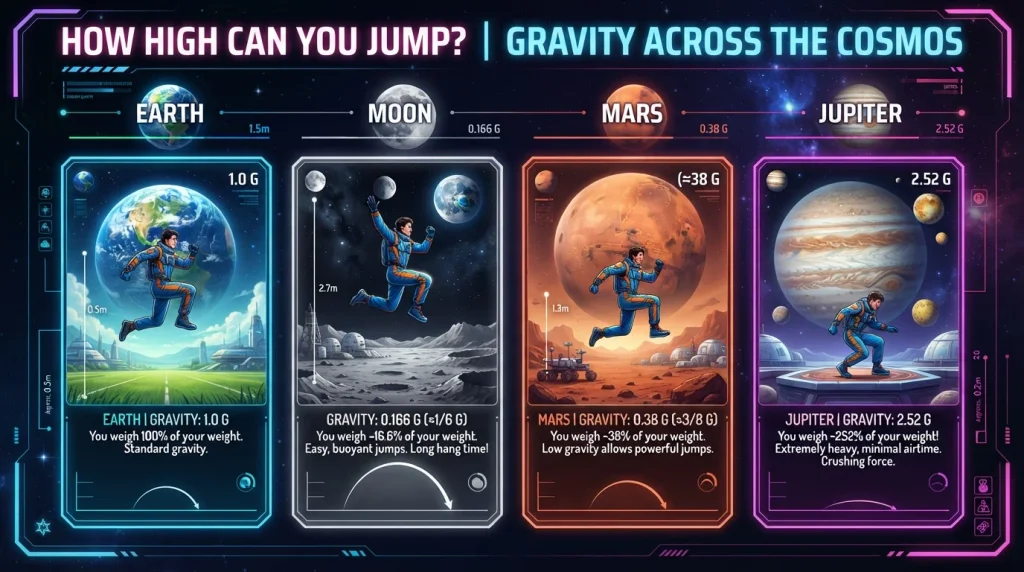
The Moon possesses roughly one-sixth of Earth’s total gravitational strength. That weak pull moves feel vastly different for visiting astronauts.
- You could jump six times higher on the lunar surface than on Earth.
- A heavy 180-pound space suit feels like a light 30-pound backpack on the moon.
- Dropping a feather and a hammer simultaneously results in both landing together due to no air resistance.
Jupiter: The Giant Heavyweight Champion
Jupiter contains more mass than all other solar system planets combined. Its immense size generates a ferocious gravitational field.
If you could stand on Jupiter’s cloud tops, you would feel two and a half times heavier. Walking would feel like carrying two extra people on your shoulders.
This massive force enables Jupiter to capture dozens of orbiting moons. It also attracts stray asteroids, acting as a cosmic shield for inner planets.
Standing on Mars Feels Like Having Superpowers
Mars sits between Earth and the Moon in terms of physical size. Its surface gravity measures roughly 38 percent of Earth’s standard gravity.
On Mars, you could easily leap over high obstacles that seem impossible here. High jumps and basketball dunks would become effortless achievements.
This lower gravity also means the Martian atmosphere slowly leaks out into space. Without heavy pull, gas molecules drift away into the void.
Wild Gravity Anomalies and Space Phenomena

Space features extreme environments where gravity acts in mind-bending ways. These cosmic phenomena stretch the limits of human imagination.
Black Holes: The Ultimate Gravitational Traps
When massive stars collapse at the end of their lives, they can form black holes. These objects pack immense mass into an infinitely small point.
A black hole’s pull becomes so strong that nothing can escape its grasp. Not even light moves fast enough to break free from its boundary.
If you stepped near a small black hole, extreme tidal forces would stretch your body long and thin. Scientists call this process spaghettification.
Gravitational Lensing: Nature’s Cosmic Telescope
Massive galaxy clusters can bend light rays traveling from distant stars behind them. This phenomenon acts like a giant magnifying lens floating in deep space.
Astronomers use gravitational lensing to spot ultra-distant galaxies hidden behind nearer structures. It allows telescopes to peer far back toward the beginning of time.
Gravitational Waves: Ripples in the Fabric of Space
When two massive black holes collide, they send shockwaves through space itself. Albert Einstein predicted these invisible ripples over a century ago.
- Gravitational waves stretch and squeeze space as they travel across the universe.
- Specialized laser detectors on Earth measured these waves for the first time in 2015.
- Colliding neutron stars also generate detectable gravitational waves that reach Earth.
How Living in Zero Gravity Changes the Human Body
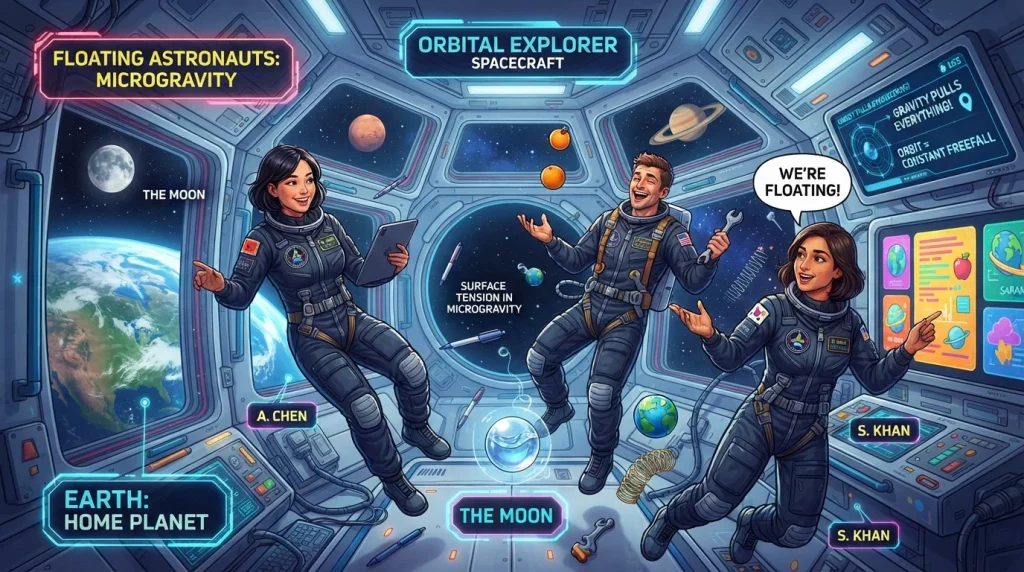
Astronauts aboard the International Space Station live in continuous freefall. This microgravity environment causes rapid changes inside the human body.
Floating Astronauts Are Actually Constantly Falling
Many people believe astronauts float because there is zero gravity in space. However, Earth’s pull at space station altitude remains about 90 percent as strong as on the ground.
The space station stays in orbit by falling toward Earth while traveling sideways extremely fast. Because the station and astronauts fall at the same speed, floating occurs.
Astronauts Grow Taller in Space
Without constant gravitational pressure pushing down on the human spine, the back cushions expand. Astronauts can grow up to two inches taller while living in space.
However, this extra height disappears shortly after returning to Earth. Gravity on Earth compresses the spine back to its original height.
Fluids Shift Upward Toward the Head
On Earth, gravity pulls bodily fluids downward into legs and feet. In microgravity, fluids spread evenly throughout the upper body.
- Astronauts develop rounded, puffy faces during their first few days in orbit.
- Nasal passages swell, making astronauts feel like they have a constant head cold.
- Leg muscles shrink because they no longer support body weight against ground pressure.
Bones Lose Density Without Constant Resistance
Earth’s gravity provides continuous resistance training for your skeletal system. Every step you take helps keep bones thick and strong.
In microgravity, bones no longer need to support weight. Astronauts lose roughly one percent of bone density every single month in space.
To combat bone loss, space crews exercise for two hours every day using specialized equipment. They use heavy resistance straps to simulate ground pressure.
Everyday Inventions We Owe to Gravity Science
Studying gravitational physics led to many modern technologies people rely on every single day.
GPS Navigation Relies on Gravity Calculations
Your smartphone’s GPS depends on satellites orbiting thousands of miles above Earth. Clocks on these satellites tick slightly faster than clocks on the ground.
Earth’s gravity slows down time near the surface compared to higher orbits. Engineers must adjust satellite clocks to account for this time variation.
Without accounting for gravity’s effect on time, smartphone directions would drift by miles every day. Navigation apps would quickly become useless.
Pendulum Clocks and Precision Timekeeping
Historical pendulum clocks used gravity’s constant pull to regulate timekeeping. A swinging pendulum takes a predictable amount of time to swing back and forth.
This steady rhythm allowed humans to create reliable mechanical timekeepers. It helped shape modern concepts of scheduled work and global trade.
Water Supply Systems Use Natural Flow
Modern cities design municipal water systems around gravitational forces. Large water towers store fresh water high above neighborhoods.
Gravity creates natural pressure, pushing water through underground pipes into household taps. This simple mechanism eliminates the need for high-powered water pumps at every house.
Fun Gravity Experiments You Can Try at Home
You don’t need an advanced physics lab to explore how gravity works. Simple household items allow you to test gravitational rules yourself.
The Leaky Cup Trick
Take a plastic cup and poke a small hole near the bottom. Cover the hole with your finger and fill the cup with fresh water.
If you uncover the hole, gravity pulls the water straight down out of the cup. Now, remove your finger and drop the cup into a soft bucket.
While the cup falls freely through the air, water stops leaking out completely. Both the cup and water fall at identical speeds, creating brief weightlessness.
The Falling Paper and Coin Race
Hold a flat piece of paper in one hand and a heavy coin in the other. Drop them simultaneously from the same height.
The heavy coin hits the floor first because air resistance resists the wide paper. Now, crumple that same paper into a tight ball and drop them again.
With air resistance removed, both items fall together and hit the floor at the same moment. Mass does not change how fast gravity pulls falling objects.
MCQs
Test your knowledge of fun gravity facts with these multiple-choice questions.
1. What force pulls objects toward the Earth?
A) Magnetism
B) Gravity
C) Friction
D) Electricity
2. Which object has the strongest gravity?
A) The Moon
B) Earth
C) Jupiter
D) Mars
3. Why do objects fall toward the ground when dropped?
A) Wind pushes them
B) Gravity pulls them
C) Light attracts them
D) Sound moves them
4. How would you feel on the Moon compared with Earth?
A) Much heavier
B) Slightly heavier
C) Much lighter
D) The same weight
5. Which planet has the greatest surface gravity among these?
A) Mars
B) Venus
C) Jupiter
D) Mercury
6. What would happen to a person’s jump on the Moon?
A) They would jump higher
B) They could not jump
C) They would jump lower
D) Nothing would change
7. What keeps planets moving around the Sun?
A) Gravity
B) Sound
C) Electricity
D) Wind
8. What happens to gravitational attraction as two objects get farther apart?
A) It gets stronger
B) It gets weaker
C) It stays the same
D) It disappears instantly
9. Which famous scientist is associated with the story of an apple and gravity?
A) Albert Einstein
B) Galileo Galilei
C) Isaac Newton
D) Nikola Tesla
10. Where would an astronaut experience much weaker gravity?
A) On the Moon
B) On Earth
C) At sea level
D) In an ocean
Answers
- B
- C
- B
- C
- C
- A
- A
- B
- C
- A
FAQs
Can gravity ever completely disappear in space?
No, gravity never drops to absolute zero anywhere in the cosmos. Every object with mass exerts some pull across vast distances. Even in deep space between distant galaxies, tiny amounts of gravitational attraction remain active.
Why do objects float inside the International Space Station?
Objects float because the space station and its crew exist in continuous freefall around Earth. The station moves sideways fast enough to match Earth’s curve as it drops. This creates a weightless environment despite strong gravity.
Who discovered that gravity affects time movement?
Albert Einstein discovered that gravity alters time through his theory of general relativity. He proved that stronger gravitational fields slow down time relative to weaker areas. High-precision atomic clocks confirm this phenomenon consistently.
Is gravity considered a strong or weak physical force?
Gravity is actually the weakest of the four fundamental forces in nature. Electromagnetic and nuclear forces are vastly stronger on subatomic scales. A small refrigerator magnet easily overcomes Earth’s entire gravitational pull to lift a clip.
What would happen to Earth if the Sun lost its gravity?
If the Sun lost its gravitational pull, Earth would fly off in a straight line into deep space. Our planet would drift away from solar light and heat. Earth would freeze rapidly within days of leaving its steady orbit.
Can humans create artificial gravity in space?
Humans can create artificial gravity by rotating spacecraft structures rapidly in space. Spinning generates centrifugal force that pushes objects outward against outer walls. This outward pressure simulates the feeling of standing on solid ground.
Conclusion
Exploring these fun gravity facts shows how much this invisible force influences our everyday lives. From keeping oceans steady to guiding massive planets, gravity shapes our universe every single second.
Understanding gravitational forces helps us appreciate how perfectly tuned Earth is for human life. It also opens exciting possibilities for future space exploration as humanity reaches toward distant stars.
Keep exploring the world around you with curiosity and wonder. Share these amazing science facts with friends to keep learning together!

Asjad Ali is a passionate, fun, and entertainment enthusiast who enjoys discovering interesting, amusing, and engaging content from around the web. Through laughvista.com, Asjad shares lighthearted ideas, entertaining stories, fun facts, jokes, and enjoyable content designed to bring a little more laughter and positivity into everyday life. His goal is to create content that feels natural, relatable, and easy for everyone to enjoy.
With a genuine interest in fun and entertainment, Asjad Ali focuses on creating friendly content for readers of different ages and backgrounds. laughvista.com is built around the idea that a few moments of laughter can brighten anyone’s day. Whether readers are looking for something funny, interesting, or simply entertaining, Asjad aims to make every visit enjoyable, refreshing, and worth coming back to.