Fun math ideas transform abstract numbers into hands-on games, practical life challenges, and engaging puzzles. By connecting math concepts to real-world scenarios, outdoor play, and creative arts, learning becomes an enjoyable, stress-free experience that boosts confidence and deepens problem-solving skills naturally for learners of any age.
Remember when math felt like a secret code you just could not crack? Many of us grew up viewing numbers as rigid rules on a chalkboard rather than a vibrant playground.
By introducing fun math ideas into daily routines, you can turn anxiety into curiosity. Learning numbers should feel less like a chore and more like an exciting adventure.
Whether you are helping a young learner or looking to sharpen your own skills, hands-on activities make concepts stick. Let us transform how you look at mathematics through simple, creative, and highly engaging methods.
Transforming How We See Numbers
Mathematics is far more than memorizing formulas for a Friday test. It is the underlying language of nature, art, music, and physical motion.
When you shift your focus from abstract equations to hands-on experiences, numbers instantly come alive. You stop asking when you will ever use these skills in real life because the answers surround you every day.
Making numeric concepts approachable opens up a world of creative discovery. Let us explore how simple tweaks to daily play can completely change your perception of problem-solving.
The Power of Playful Learning
Play lowers stress and helps the brain build stronger neural connections. When learners play games, they analyze data and make strategic decisions without realizing they are practicing core skills.
A simple card game can teach addition speed better than a traditional printed worksheet. Board games naturally encourage spatial awareness, logical forecasting, and strategic estimation.
When failure carries zero negative consequences, learners take more creative risks. That freedom to experiment builds long-term confidence and real mathematical resilience.
Moving Away from Rote Memorization
Memorizing facts through sheer repetition often creates boredom and quick burnout. Understanding why a pattern works builds true mathematical intuition that lasts for a lifetime.
When you understand the visual reason behind multiplication, you do not need flashcards to remember facts. You can picture equal groups in your head and build the answer logically.
This foundational shift transforms math from an exercise in recall to an active puzzle-solving adventure. It invites active exploration rather than silent memorization.
Creative Math Games for Home and Classroom
Games bring healthy competition, shared laughter, and high energy into learning spaces. You do not need expensive kits or fancy technology to get started with interactive games.
Most engaging activities rely on common household items like dice, playing cards, sidewalk chalk, or paper clips. The key is combining physical movement with quick mental calculation.
Here are several versatile concepts that turn standard practice sessions into interactive play that everyone looks forward to.
Card and Dice Challenges
A standard deck of playing cards is one of the most powerful teaching tools available. Remove the face cards, deal two cards to each player, and race to multiply them together.
You can tweak the rules easily to practice subtraction, fractions, or even negative numbers. The player with the highest correct product keeps the cards for that round.
Rolling dice introduces random chance and keeps every participant on their toes. Try rolling four dice at once and using any combination of operations to hit a target number.
Outdoor Number Adventures
Taking learning outdoors breaks up monotony and adds vital physical movement to the learning process. Use sidewalk chalk to draw a giant number line or a customized hopscotch grid.
Call out equations and have players jump to the correct answer on the pavement. The physical motion reinforces numerical relationships while burning off extra energy.
You can also organize a geometry scavenger hunt in your neighborhood park or backyard. Challenge participants to spot parallel lines, acute angles, and symmetrical patterns in plants or architecture.
Kitchen Math: Delicious Real-World Practice
The kitchen is essentially a delicious, hands-on laboratory for active problem-solving. Cooking and baking require precise measurement, accurate timing, and proportional adjustments.
When learners work with recipes, they interact directly with fractions, ratios, and real-world conversions. Best of all, the final reward is a tasty snack you can enjoy together.
Here is how you can turn everyday meal prep into a rich learning environment without ruining dinner.
Doubling and Halving Recipes
Take a simple cookie recipe designed for four people and adjust it to feed six instead. This requires multiplying fractions and mixed numbers using practical, physical ingredients.
Ask questions like how many half-cups fit into two and a half cups of flour. Measuring ingredients directly gives abstract fractions immediate visual meaning.
If a recipe calls for three-fourths of a cup of sugar and you want to halve it, work through the problem together using measuring spoons.
Geometry in Baking and Pizza Making
Pizza preparation offers a perfect platform for exploring circles, angles, fractions, and area. Discuss how cutting a circular pie into eight equal slices creates specific angular segments.
Compare the total surface area of one large circular pizza versus two smaller circular pizzas. You might be surprised by how much math goes into getting the best food value.
Baking square brownies introduces array patterns and grid estimation naturally. Dividing a baking pan into equal portions tangibly demonstrates basic division principles.
Everyday Activities for Practical Skills
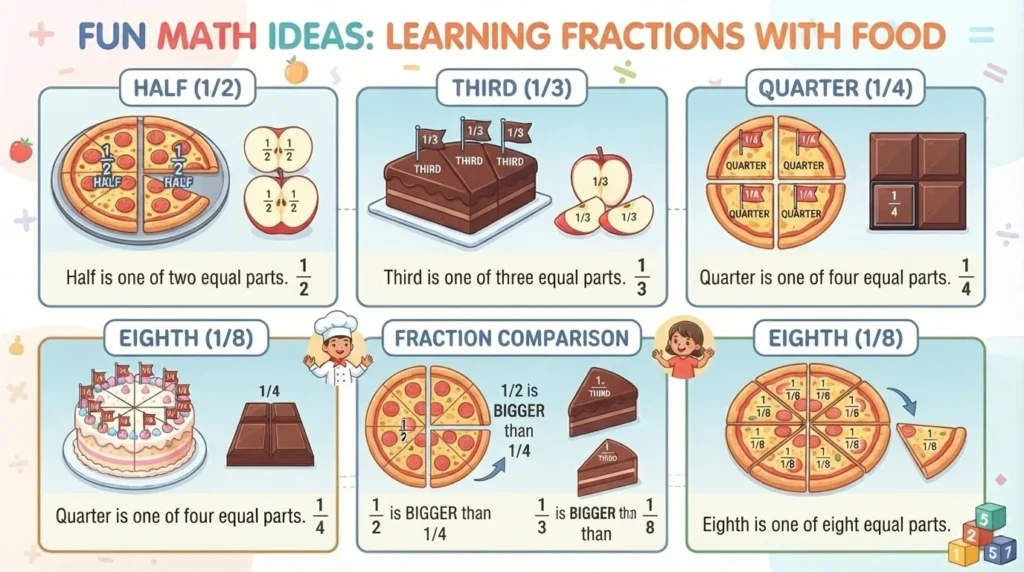
Connecting numerical thinking to daily routines helps demystify abstract ideas completely. When you highlight math in everyday life, learners realize they are already using these skills constantly.
From budgeting pocket money to planning road trips, daily choices are packed with practical analytical moments. Capitalize on these moments through natural conversation.
Let us look at two simple daily scenarios where basic numbers shine bright.
Shopping on a Budget
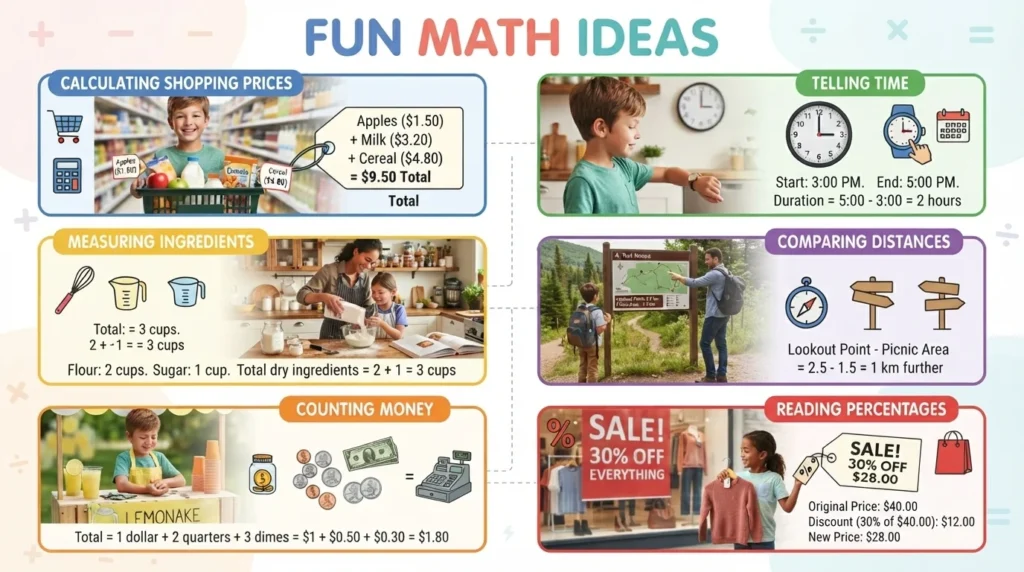
Take your learner along to the grocery store with a specific cash limit and a small shopping list. Challenge them to keep a running total of items placed in the shopping cart.
Calculate discounts by figuring out twenty percent off select items before reaching the checkout counter. Comparing unit prices on cereal boxes teaches valuable division and critical consumer thinking.
This practice grounds decimal addition and subtraction in real consequences. It turns a standard store visit into a high-stakes budgeting game.
Travel and Distance Calculations
Turn long car rides or public transit trips into interactive navigation challenges. Use real paper maps or GPS distance readings to calculate estimated arrival times together.
Ask how fast you need to drive to travel sixty miles in forty-five minutes. Tracking speedometers and fuel consumption introduces rates and ratios in an accessible context.
Learners quickly grasp how speed, distance, and time interact on real highways. It converts passive transit time into an engaging logic puzzle.
Art and Nature: Seeing Math in the World Around Us
Math is not confined to human-made structures and graph paper booklets. The natural universe operates on precise geometric patterns and beautiful mathematical sequences.
Combining artistic expression with logical exploration engages creative thinkers who might otherwise shy away from numbers. Art makes mathematical precision visually breathtaking.
Discovering patterns in nature builds deep curiosity about how our physical world operates beneath the surface.
Drawing with Tessellations and Fractals
Tessellations are repeating geometric patterns that fit together seamlessly without any gaps or overlaps. Artists like M.C. Escher used these principles to create astonishing, brain-bending art.
You can create simple tessellations using basic index cards, scissors, and colored markers. Tracing a custom geometric shape across paper demonstrates symmetry and spatial transformation directly.
Fractals are infinitely complex patterns that repeat self-similar shapes at different scale sizes. Drawing simple fractal trees introduces concepts of exponential growth through peaceful art sessions.
Fibonacci in Nature
The Fibonacci sequence is a series of numbers where each term is the sum of the two preceding ones. You begin with zero and one, leading to one, two, three, five, eight, and beyond.
This exact mathematical pattern appears everywhere across the natural organic world. You can spot it in pinecone spirals, sunflower heads, seashells, and tree branch distributions.
Go on a nature walk specifically searching for plant structures that follow this sequence. Connecting natural beauty to numerical sequences inspires genuine awe and wonder.
Advanced Concepts Made Simple for Curiosity
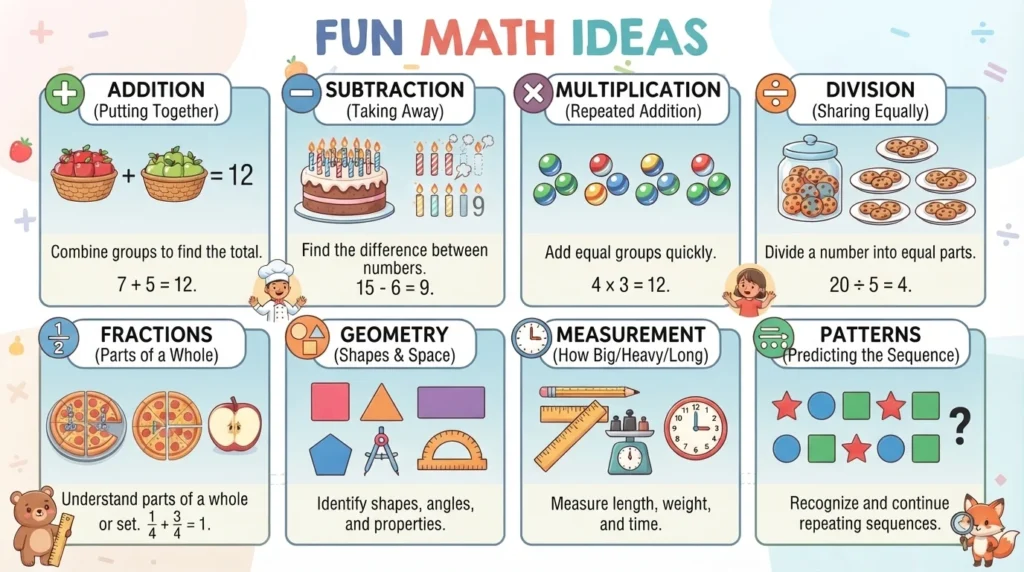
Advanced topics like probability, statistics, and algebraic balance often intimidate beginners due to complex symbols. However, the core logic behind these ideas is straightforward when presented visually.
Stripping away heavy technical jargon allows anyone to grasp sophisticated concepts effortlessly. You do not need calculus to think like a high-level scientist or statistician.
Let us explore advanced ideas using everyday objects you already have around your house.
Understanding Probability with Coin Tosses
Probability measures how likely an event is to happen during any given trial. Grab a simple coin and flip it twenty times while recording your results on paper.
Compare your actual physical results against the theoretical fifty-percent expectation. This simple experiment introduces sample sizes, random distribution, and statistical variance without complex formulas.
Try expanding the experiment by using colored marbles in a paper bag. Predicting your chances of pulling out a red marble builds intuitive statistical thinking fast.
Visualizing Algebra with Balance Scales
Algebra is really just a puzzle game about maintaining perfect balance on two sides of an equals sign. Picture a classic mechanical balance scale with unknown weights hidden inside small gift boxes.
If two identical boxes plus three one-pound weights balance with nine one-pound weights, what does one box weigh? Visualizing the problem lets you solve for the unknown variable without writing complex equations.
Removing equal weight from both sides keeps the scale perfectly balanced while revealing the answer. This visual technique removes the fear from variables and equations forever.
MCQs
- If you scale a recipe that serves 4 people up to serve 6 people, by what factor must you multiply each ingredient? A. 1.2
B. 1.5
C. 2.0
D. 2.5 - Which sequence of numbers is formed by adding the two previous numbers together?
A. Prime Sequence
B. Exponential Sequence
C. Fibonacci Sequence
D. Geometric Progression - What geometric pattern covers a surface completely using repeating shapes with zero gaps or overlaps?
A. Tessellation
B. Fractal
C. Symmetry
D. Parabola - If a store offers a 20% discount on a $45 jacket, what is the final price before tax?
A. $32
B. $35
C. $36
D. $40 - You roll a standard six-sided die once. What is the probability of rolling an even number?
A. 1/6
B. 1/3
C. 1/2
D. 2/3 - A car travels at a constant speed of 60 miles per hour. How many minutes will it take to drive 15 miles?
A. 15 minutes
B. 20 minutes
C. 25 minutes
D. 30 minutes - A circular pizza is cut into 8 equal slices. What is the angle measure of a single slice?
A. 30 degrees
B. 45 degrees
C. 60 degrees
D. 90 degrees - In an algebraic balance scale puzzle, $2x + 4 = 12$. What is the value of $x$?
A. 3
B. 4
C. 5
D. 6 - What term describes a pattern that repeats similar details at smaller and smaller scales indefinitely?
A. Matrix
B. Vector
C. Polygon
D. Fractal - If you flip a fair coin three times in a row, what is the total number of possible outcome combinations?
A. 4
B. 6
C. 8
D. 12
Answer Key
B
C
A
C
C
A
B
B
D
C
FAQs
How can I help a child who feels anxious about math?
Start by removing time limits and high-pressure testing situations. Introduce playful fun math ideas like card games, outdoor movement, and art projects. Focus on celebrating logical strategies rather than speed to build confidence slowly over time.
Are physical manipulatives useful for older learners?
Yes, hands-on objects help learners of all ages clarify abstract ideas. Using visual blocks, balance scales, or geometric paper models helps adults and teens master spatial reasoning and algebraic concepts far faster than reading static textbooks.
How do fun math activities improve long-term retention?
Interactive activities engage multiple senses simultaneously, creating richer neural connections in the brain. When learning connects to emotional enjoyment, real movement, or practical life tasks, information moves naturally into long-term memory instead of short-term storage.
Can fun math ideas work in a large classroom?
Absolutely, group activities and team-based games adapt wonderfully to large classrooms. Station-based learning, board games, and outdoor group scavenger hunts allow students to collaborate, discuss logical strategies, and solve complex problems together naturally.
How much time should we spend on math games daily?
Just ten to fifteen minutes of intentional, enjoyable practice daily works wonders. Consistency matters far more than long sessions that induce fatigue. Short, frequent play keeps energy levels high and maintains steady educational momentum.
Conclusion
Transforming numbers from intimidating obstacles into playful challenges opens up endless creative possibilities. By incorporating practical cooking activities, outdoor movement games, artistic tessellations, and simple card challenges, you make learning accessible for everyone.
Math is not a rigid set of rules saved for the classroom. It is an exciting, dynamic lens through which we can explore and enjoy the world around us.
Try introducing one or two fun math ideas into your daily routine this week. You will quickly see how a small shift in approach creates lasting confidence and genuine curiosity.

Asjad Ali is a passionate, fun, and entertainment enthusiast who enjoys discovering interesting, amusing, and engaging content from around the web. Through laughvista.com, Asjad shares lighthearted ideas, entertaining stories, fun facts, jokes, and enjoyable content designed to bring a little more laughter and positivity into everyday life. His goal is to create content that feels natural, relatable, and easy for everyone to enjoy.
With a genuine interest in fun and entertainment, Asjad Ali focuses on creating friendly content for readers of different ages and backgrounds. laughvista.com is built around the idea that a few moments of laughter can brighten anyone’s day. Whether readers are looking for something funny, interesting, or simply entertaining, Asjad aims to make every visit enjoyable, refreshing, and worth coming back to.