
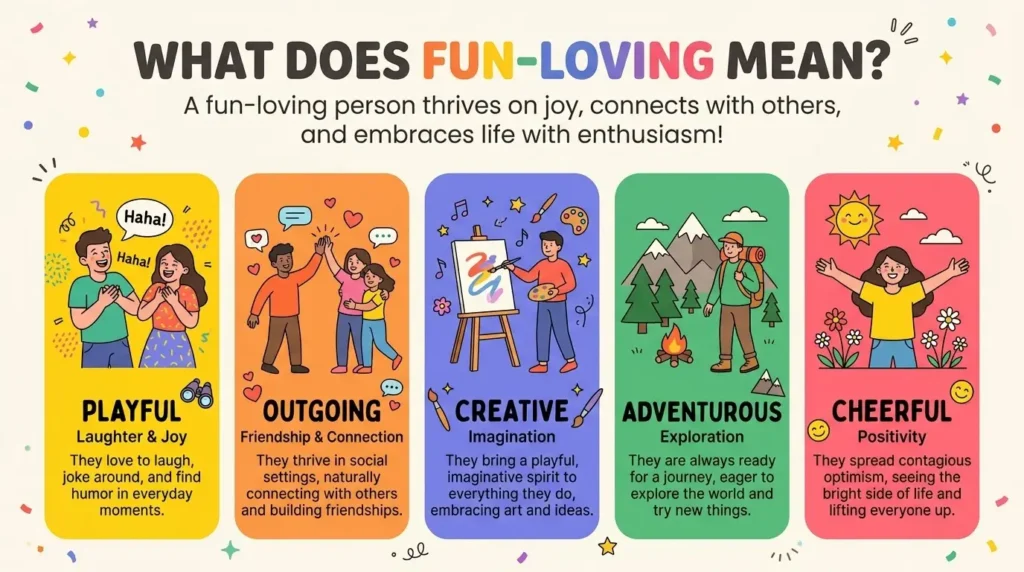
A fun-loving person is someone with a bright, spontaneous, and warm approach to life. They naturally seek out joy, spread positivity, bring lighthearted energy to their social circles, and find delight in everyday moments without taking themselves too seriously or overthinking small setbacks.
Have you ever met someone whose presence instantly brightens a dark room? They walk into a gathering and bring an effortless wave of laughter, warmth, and fresh energy.
Understanding the true fun-loving definition goes far deeper than simply knowing who likes to throw parties or tell good jokes. It is actually a fundamental mindset, an upbeat personality framework, and a beautiful way of moving through the world.
Let us explore what makes these vibrant individuals tick, how science explains their sunny disposition, and how you can cultivate more of this delightful energy yourself.
What Is the True Fun-Loving Definition?
When you look closely at the concept, being fun-loving means having a natural enthusiasm for life and a deep desire to enjoy your experiences. It represents a warm disposition that treats life as an exciting adventure rather than a heavy chore.
People who fit this description actively look for pleasure, humor, and connection in ordinary places. They choose to focus on possibilities and delight rather than getting bogged down by daily frustrations.
This trait is not about ignoring life’s real problems or pretending sadness does not exist. Instead, it is about maintaining a lighthearted baseline that helps you bounce back from difficulties with a smile.
The Psychology Behind a Fun-Loving Personality
Psychologists often associate this mindset with high levels of extroversion, agreeableness, and psychological resilience. People who embody this style usually score high in openness to new experiences.
Their brains naturally respond strongly to positive stimuli and social connections. They process daily stressors by looking for silver linings and playful solutions.
This dynamic mental framework allows them to hold onto optimism even when circumstances get tough. It acts as an emotional shock absorber against anxiety.
Misconceptions About Being Fun-Loving
Many people mistakenly assume that a playful person lacks seriousness, ambition, or emotional depth. That could not be further from the truth.
Being joyful does not mean you are foolish, irresponsible, or incapable of having deep conversations. It simply means you choose not to carry unnecessary tension into every situation.
In fact, many high-achieving professionals and deep thinkers maintain a wonderfully playful spirit. They use humor to keep stress low and creativity high.
Core Traits of a Truly Fun-Loving Individual
You can usually spot these joyful souls within a few minutes of meeting them. They share several distinct behavioral patterns that set them apart from the crowd.
1. Spontaneity and Flexibility
Rigid schedules rarely limit someone with a playful heart. They are almost always open to sudden detours, unexpected adventures, and last-minute plans.
If a sudden rainstorm ruins an outdoor picnic, they will turn it into an indoor living room fort challenge. They adapt gracefully when things do not go as planned.
Their ability to pivot makes them delightful companions during travel or unpredictable situations. They see surprises as adventures rather than annoying interruptions.
2. A Ready Sense of Humor
Humor is the universal language of lighthearted people. They laugh easily, often, and especially at themselves.
They do not use mean-spirited sarcasm or put-downs to make people laugh. Instead, they find silly moments in daily life and share those smiles freely.
Their humor acts as a bridge that instantly puts others at ease. It breaks down social barriers and creates instant comfort.
3. Genuine Warmth and Inclusivity
A playful spirit is naturally welcoming to everyone around them. They hate seeing anyone left out or feeling uncomfortable in a group setting.
They ask questions, listen with warm attention, and pull quiet people into the conversation. Their energy feels safe and non-judgmental.
People naturally gravitate toward them because being around them makes everyone feel happier about themselves.
4. High Curiosity and Childlike Wonder
Think about how a young child looks at a shiny beetle or a colorful puddle. Joyful adults retain that exact same sense of wonder.
They love learning weird facts, trying unusual foods, and exploring unfamiliar places. Curiosity keeps their minds young and vibrant.
They never grow bored because they view the world as a giant playground full of secrets waiting to be discovered.
5. Emotional Resilience and Optimism
When life throws obstacles in their path, these individuals feel pain just like anyone else. However, they do not stay stuck in negative feelings for long.
They use hope and humor as natural coping mechanisms to rebuild their energy. They believe that bad days are temporary and better moments are right around the corner.
This optimistic outlook gives them the courage to try again after facing failures.
Comparing Personality Mindsets
To better understand how this trait shapes daily behavior, let us compare how different mindsets handle common life situations.
The Surprising Benefits of Living Joyfully
Adopting a lighter approach to life yields massive rewards for your mind, body, and personal relationships. Science continues to prove that happiness is good for your health.
Physical Health Upgrades
Laughter and lighthearted living reduce stress hormones like cortisol in your body. Lower stress means better blood pressure, improved heart health, and a stronger immune system.
When you laugh, your brain releases endorphins, which are natural feel-good chemicals that reduce physical pain. It is almost like a free, natural health tonic.
People who laugh frequently also sleep better and experience less muscular tension throughout their bodies.
Emotional and Mental Well-being
A playful mindset protects you against burnout and chronic fatigue. It gives your mind regular breaks from heavy problem-solving.
When you permit yourself to play, you reduce symptoms of anxiety and sadness. You develop greater self-compassion and lower perfectionism.
It allows you to enjoy the present moment instead of constantly worrying about future problems.
Stronger Personal and Professional Relationships
People love being around friends and coworkers who bring positive energy to the table. Playfulness builds strong social bonds very quickly.
In romantic relationships, shared humor and fun keep the spark alive through decades of shared life. It acts as a safety cushion during tough arguments.
At work, lighthearted employees tend to be better collaborators and creative problem solvers.
Fascinating Facts About Laughter and Fun
The Science of Smiles
Did you know that children laugh around three hundred times a day, while the average adult laughs only fifteen times? Somewhere along the path to adulthood, many people forget how to play.
However, your brain cannot easily distinguish between a fake smile and a real smile. Smiling intentionally actually tricks your nervous system into releasing serotonin and dopamine.
This means you can physically boost your mood just by softening your facial expressions and smiling more often.
Social Laughter Is Contagious
Laughter evolved as a social bonding signal long before humans developed complex spoken languages. It told crewmembers that everything was safe and secure.
When you hear someone laugh heartily, your brain’s premotor drive automatically prepares your face to join in. It is a biological reaction designed to connect us with our crew.
Sharing a laugh builds instant trust faster than almost any other human interaction.
How to Cultivate a More Fun-Loving Spirit

If you naturally lean toward being serious or cautious, do not worry. Being joyful is a skill you can intentionally practice and strengthen over time.
Step 1: Reclaim Your Inner Child
Think back to what brought you pure, unfiltered joy when you were seven or eight years old. Was it riding a bicycle fast down a hill, coloring, or building things?
Try bringing small versions of those childish activities back into your weekend routine. Stop worrying about whether you look silly or professional.
Give yourself unconditional permission to play without needing a productive reason.
Step 2: Practice Lightening Up Daily
When minor inconveniences happen, ask yourself a quick question: “Will this matter in five years?” If the answer is no, try to find the absurd humor in it.
Spill coffee on your shirt? Laugh at your clumsiness, change your top, and move on with your day.
Choosing to smile at small blunders saves you hours of unnecessary frustration.
Step 3: Surround Yourself with Upbeat People
Moods are incredibly contagious. If you spend all your free time with chronic complainers, you will slowly adopt their heavy viewpoint.
Seek out friends who love to laugh, explore new places, and share positive stories. Their vibrant energy will naturally rub off on you.
Join social clubs, hobby groups, or sports teams focused on enjoyment rather than intense competition.
Step 4: Say Yes to Unplanned Micro-Adventures
Break out of your rigid daily routines by accepting unexpected invitations. Say yes to that spontaneous weeknight ice cream run or weekend road trip.
Small detours make life memorable. Nobody looks back on their life and remembers the night they folded laundry perfectly on schedule.
They remember the unexpected midnight beach walks and silly karaoke sessions.
Step 5: Stop Caring So Much About Judgment
The biggest blocker to a playful life is the fear of looking foolish in front of strangers. You must let go of that heavy weight.
The truth is that most people are far too busy worrying about themselves to judge you for long.
Dance awkwardly at weddings, sing along to the radio with the windows down, and wear silly socks if it makes you smile.
Common Obstacles to Joy and How to Overcome Them

Even the most cheerful people face mental blocks that threaten to steal their light. Recognizing these traps helps you avoid them.
Perfectionism
Perfectionism tells you that every activity must have a productive goal or a flawless result. It destroys the spirit of play.
To defeat perfectionism, deliberately engage in hobbies where you are terrible at the skills involved. Paint messy pictures or play a new musical instrument badly.
Enjoy the process of doing things purely for entertainment, not for achievement or praise.
Chronic Busyness
When your daily schedule is packed with endless tasks, play feels like a luxury you cannot afford. You end up exhausted and emotionally drained.
Treat free time as a non-negotiable appointment on your weekly calendar. Protect your rest days just as fiercely as you protect work meetings.
Remember that rest and play are essential fuels for long-term success.
Social Anxiety
Feeling self-conscious makes it hard to relax and express joy openly. You might worry about being judged or saying the wrong thing.
Start small by practicing humor and playfulness around trusted friends or family members. As your confidence grows, bring that light energy to wider circles.
Focus your attention outward on making others feel comfortable, which takes the spotlight off your anxieties.
Practice Exercises
Test your knowledge of the fun-loving definition and personality dynamics with these ten practice questions.
1. What does “fun-loving” mean?
A) Someone who dislikes people B) Someone who enjoys having fun C) Someone who avoids activities D) Someone who likes working alone
2. Which word is a synonym for fun-loving?
A) Cheerful B) Angry C) Serious D) Lazy
3. Which activity might a fun-loving person enjoy?
A) Avoiding all social events B) Refusing to play games C) Playing games with friends D) Staying upset all day
4. What type of personality is often associated with a fun-loving person?
A) Playful B) Unfriendly C) Rude D) Uninterested
5. Which sentence uses “fun-loving” correctly?
A) The fun-loving child enjoys playing with friends. B) The fun-loving child hates every game. C) The fun-loving person dislikes laughter. D) The fun-loving family never enjoys activities.
6. What part of speech is “fun-loving”?
A) Noun B) Verb C) Adjective D) Adverb
7. What does a fun-loving person usually enjoy?
A) Making enjoyable memories B) Avoiding happiness C) Creating arguments D) Disliking everyone
8. Which word is closest in meaning to “fun-loving”?
A) Lighthearted B) Hostile C) Unhappy D) Unkind
9. Which situation best describes a fun-loving family?
A) A family that never spends time together B) A family that enjoys playing games together C) A family that avoids every celebration D) A family that dislikes all activities
10. What is the main idea of the word “fun-loving”?
A) Enjoying fun and exciting experiences B) Avoiding other people C) Always being serious D) Disliking new experiences
Answer Key
- B) Someone who enjoys having fun
- A) Cheerful
- C) Playing games with friends
- A) Playful
- A) The fun-loving child enjoys playing with friends.
- C) Adjective
- A) Making enjoyable memories
- A) Lighthearted
- B) A family that enjoys playing games together
- A) Enjoying fun and exciting experiences
FAQs
What is the exact fun-loving definition in simple terms?
A fun-loving person is someone who naturally seeks out joy, laughter, and lighthearted experiences. They maintain an optimistic attitude, embrace spontaneity, and enjoy making others smile throughout their everyday lives.
Can an introvert be considered fun-loving?
Yes, introverts can absolutely have a vibrant, fun-loving personality. While they may prefer smaller gatherings or quiet hobbies, their playful spirit shows up through subtle humor, creative play, and warm connections with close friends.
Is being fun-loving a genetic trait or a learned skill?
It is a mix of both nature and nurture. While some people are born with higher baseline optimism, anyone can intentionally develop a more playful mindset by practicing gratitude, letting go of perfectionism, and choosing joy daily.
How do I deal with people who constantly criticize my cheerful energy?
Protect your positive energy by setting healthy boundaries with negative individuals. Understand that their criticism usually reflects their internal stress, so continue shining your light without taking their comments personally.
Can a fun-loving mindset improve workplace productivity?
Yes, playfulness boosts creativity, reduces workplace stress, and improves team collaboration. Employees who share lighthearted moments communicate better and solve complex problems with greater flexibility and enthusiasm.
How does playfulness change as people age into retirement?
Playfulness often increases during retirement because adults have more free time to pursue passions. Joyful older adults maintain better physical health, sharp cognitive function, and rich social lives by continuing to play daily.
What is the fastest way to bring more fun into a boring routine?
The fastest way is to add small elements of play to routine tasks. Listen to upbeat music while cooking, make a game out of cleaning, or try a new route during your daily walk home.
Conclusion
Understanding the fun-loving definition shows us that joy is not just a random emotion that happens to us. It is an active, beautiful choice in how we react to the world.
When you choose to laugh at small mistakes, stay open to surprises, and share warmth with strangers, your life becomes richer and far more rewarding. You do not need to change your entire identity overnight; just start by looking for small reasons to smile today.
Bring a spark of playfulness into your next conversation, dance to your favorite song, and remember that life is meant to be enjoyed, not just endured!

Asjad Ali is a passionate, fun, and entertainment enthusiast who enjoys discovering interesting, amusing, and engaging content from around the web. Through laughvista.com, Asjad shares lighthearted ideas, entertaining stories, fun facts, jokes, and enjoyable content designed to bring a little more laughter and positivity into everyday life. His goal is to create content that feels natural, relatable, and easy for everyone to enjoy.
With a genuine interest in fun and entertainment, Asjad Ali focuses on creating friendly content for readers of different ages and backgrounds. laughvista.com is built around the idea that a few moments of laughter can brighten anyone’s day. Whether readers are looking for something funny, interesting, or simply entertaining, Asjad aims to make every visit enjoyable, refreshing, and worth coming back to.